
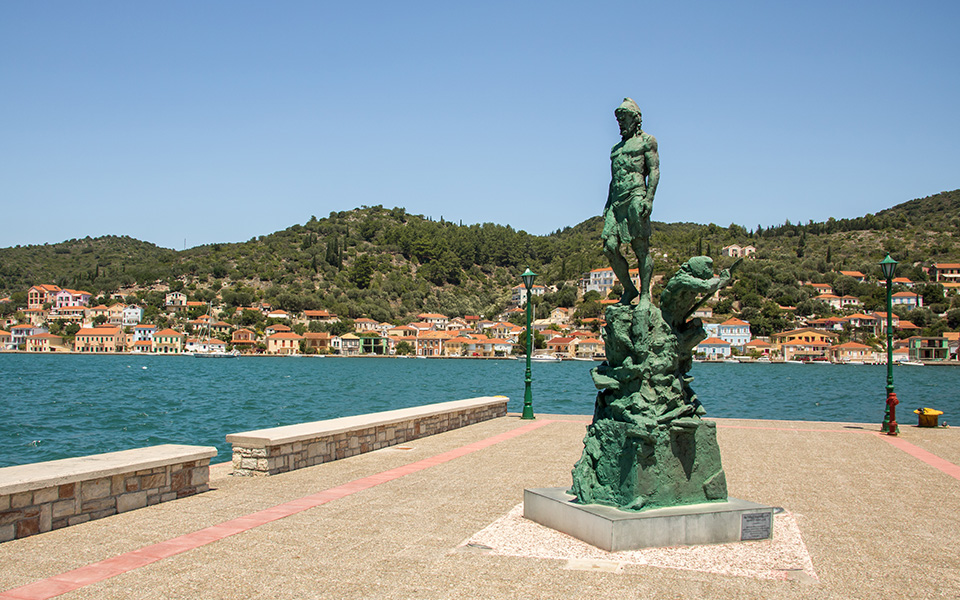
Everyone thinks they know where Odysseus lived—until they read Homer closely. Then the map begins to slip. “Ithaca” turns out to be part coastline, part memory, part riddle the poem sets for us to solve.
The Puzzle Homer Leaves Us
Homer does not hand us a GPS pin. Instead, he gives a handful of clues that tug in different directions:
- Ithaca is “rocky,” “low-lying,” and “the farthest toward the sunset” among nearby islands.
- It sits near Zakynthos, Same, and Doulichion.
- Its harbors are sheltered; its interior is rugged; it has a cave sacred to the Nymphs.
- From the palace you can look out toward the mainland and the rising sun.
Read quickly, those lines point to the modern island called Ithaki (Ithaca) in the Ionian Sea. Read carefully, they complicate the picture. Is Ithaca the westernmost island (toward the sunset) or the easternmost (facing the dawn)? How do we square “low-lying” with “rocky”? Why does Homer sometimes treat “Same” as distinct from—and sometimes as a poetic double for—Kefalonia?
For three thousand years, readers have been chasing these contradictions across the Ionian blue.
Candidate #1: The Obvious Choice—Modern Ithaki
If you open a contemporary map, you’ll find an island named “Ithaca” northeast of Kefalonia. It has a storied harbor at Vathy, a dramatic north–south ridge, and a clustering of Mycenaean-era sites: Pilikata, Aetos, and Polis Bay (with the submerged “Cave of the Nymphs,” also called the Cave of Loïzos). Local tradition has long pointed to this island as Odysseus’ home; ancient travelers did the same.
Strengths of the case
- Continuity of name and cult: “Ithaca” is Ithaca, and there are cult traces and inscriptions linking the place to Odysseus in antiquity.
- Archaeological texture: The island shows continuous occupation from the Late Bronze Age into the Classical period, with elite-looking hill sites that could plausibly anchor a petty kingdom.
- Homeric fit: Sheltered coves, steep ground, scant plains—Homer’s “rocky” adjective feels right.
Headaches
- Homer calls Ithaca “the farthest toward the west (sunset)” among neighboring islands. Modern Ithaki sits east of massive Kefalonia, not west of it. Explaining this away usually involves saying Homer’s “west” refers to the island group as seen from the mainland or that “farthermost” is a loose poetic flourish.
The standard solution—“names stick, poems stretch”—still convinces many classicists. If you value continuity of cult, toponyms, and plausible Mycenaean hamlets, Modern Ithaki works.
Candidate #2: The Disruptor—Paliki (Western Kefalonia)
A newer, provocative theory proposes that “Ithaca” was not the small island of today but the Paliki peninsula, the western prong of Kefalonia. The claim’s hinge is geological: in the Late Bronze Age, tectonics and landslides may have opened a narrow marine channel between Paliki and the rest of Kefalonia, making Paliki a separate island. If so, it would have been the westernmost of the local group—suddenly matching Homer’s “toward the sunset” line perfectly.
Strengths of the case
- Directional precision: If Paliki was once detached, Homer’s geography snaps into alignment: westmost, facing east to the mainland, near Same/Kefalonia and Zakynthos.
- Topographic feel: Paliki is rugged with small arable pockets, fitting a “rocky, low-lying” island with scant plains.
- Harbors & caves: The topography offers several candidate coves and cave sites that can be read against Homer’s imagery.
Headaches
- Geology must carry the argument. You need convincing evidence that a navigable strait existed c. 1200–800 BCE and later silted shut. Some studies suggest it’s plausible; others see no clear marine channel deep enough for Bronze Age traffic.
- Cult and continuity: Paliki lacks the clear, long-running “Odysseus here” cultic footprint that modern Ithaki boasts.
If you prize textual exactitude—“farthest west” means farthest west—Paliki is seductive. But it leans heavily on Earth’s slow machinery to rewrite the coast.
Candidate #3: The Old Maverick—Lefkada (Leucas)
In the late 19th and early 20th centuries, the archaeologist Wilhelm Dörpfeld—famed for digs at Troy and Tiryns—argued that Lefkada, not Ithaki, was Odysseus’ isle. In antiquity, Lefkada was attached to the mainland by a movable causeway; in a sense, it was an “almost island,” with a lagoon and striking eastern view.
Strengths of the case
- “Facing the dawn” fits an eastern-facing palace site.
- Proximity to the mainland fits Homer’s quick sailing hops and Odysseus’ stealthy returns.
Headaches
- Neighbor list mismatch: Aligning Homer’s Same, Doulichion, and Zakynthos with Lefkada’s neighborhood gets messy.
- Archaeology: While Lefkada has Bronze Age remains, tying them to a royal center that matches Odysseus’ scale is speculative.
Lefkada remains a romantic outsider: possible, but the poem’s island cluster feels less at home there.
The Others in the Chorus
- Kefalonia proper (not just Paliki): Some read “Same” as a poetic epithet for Kefalonia and imagine “Ithaca” as a district on it. This asks us to treat Homer’s island list as flexible labels for regions rather than fixed island identities.
- Zakynthos as a fixed point: Because Homer explicitly lists Zakynthos alongside Ithaca, any solution must leave Zakynthos where it is and still satisfy the “westmost”/“east-facing” tension.
What Archaeology Really Tells Us
Archaeology won’t hand us a deed to Odysseus’ palace, but it provides three crucial realities:
- Mycenaean mini-kingdoms dotted the Ionian. Small, defensible hill sites with storage, limited farmland, and good harbor access match the economy and scale implied in the Odyssey—a world of oared ships, gift exchange, cattle wealth, and rival “kings” who are closer to magnates than emperors.
- Cult sticks to names. Where a name endures, rituals bloom. Modern Ithaki’s inscriptions and votives to Odysseus and the Nymphs show how quickly poetry crystalizes into place—a feedback loop between text and site.
- Coastlines move. Tectonics, subsidence, and landslide dams can alter harbors and channels over centuries. The Ionian is geologically lively. A Homeric “island” could be a peninsula later—or vice versa.
Archaeology, in other words, narrows the plausible, but it doesn’t force a verdict.
Reading Homer Without Forcing the Map
The Odyssey is not a pilot’s manual—it is a poem about nostos, the ache of getting home. Its geography is a mood board: precise enough to be believable, elastic enough to carry meaning.
A few interpretive keys help:
- Poetic directionality: “Farthest toward the sunset” can be a sailor’s idiom (westmost in a local circuit), not a cartographer’s axiom. Ancient wayfinding mixes bearings with experiential landmarks: “the one beyond Same,” “the one under the setting light,” “the island that faces the dawn from the palace hill.”
- Layered toponyms: Names in oral epic are palimpsests. “Same” can be both a specific island and a larger region (Kefalonia). “Doulichion” may refer to the fertile lowlands of the mainland opposite, or to an islet whose name later died.
- Symbol over survey: Ithaca is intentionally small and stony. It dramatizes a theme: Odysseus’ kingdom is not opulent Mycenae; it’s a marginal, stubborn place that rewards cunning and endurance. The land mirrors the man.
When we stop asking Homer to be a hydrographer and ask instead what his geography does, we see why he made Ithaca both “rocky” and “low-lying,” both “westmost” and “facing dawn.” Ithaca sits at a seam: between sea and shore, darkness and day, wandering and home.
So… Where Was Ithaca?
If you want a modern pin, two answers are respectable:
- Modern Ithaki: best on cult continuity, local archaeology, and traditional identification.
- Paliki-as-island (western Kefalonia): best on literal alignment with Homer’s directional language, if the geological strait once existed.
Lefkada and Kefalonia-proper have their defenders, but they wear heavier interpretive costs.
If you want a Homeric answer, it’s simpler and more unsettling: Ithaca is the place where longing ends. The poem keeps the coordinates slightly indeterminate so the experience can be general. Sailors who have been gone too long know the feeling—home is both a specific cove and a moving target. It is the harbor you can name and also the horizon you never stop chasing.
Deconstructing the Myth Without Killing the Magic
To “deconstruct” in this context is not to flatten the story; it is to notice the gears:
- The Odyssey fuses oral geography (sailor’s directions) with moral cartography (a map of the heart).
- Competing sites reflect an ancient habit: attach poems to places to claim prestige and pilgrims.
- Geological time and epic time don’t keep the same calendar; coastlines drift while verses harden.
Seen this way, the dispute over Ithaca’s address isn’t a nuisance; it’s the poem’s afterlife. Each theory—Modern Ithaki, Paliki, Lefkada—reveals what we value most: continuity, exactitude, or romance.
Homer, I suspect, would be pleased. He wrote a world roomy enough to let us keep sailing.
If You Go Looking
- On Modern Ithaki: Walk from Aetos to Pilikata; sit above Polis Bay where the Cave of Loïzos sinks beneath the waterline; feel how quickly “rocky” becomes home when a north wind dies in the cove.
- On Kefalonia/Paliki: Trace the proposed ancient channel’s line with your eyes; imagine oared hulls slipping through at dawn and the western cliffs taking the last light.
- Everywhere: Read a few lines of the Odyssey aloud near sunset. The poem’s compass still finds north when the sea darkens and the first harbor lamp flickers on.
In the end, the quarrel over Ithaca’s coordinates resolves the way the epic does: not by a tidy proof, but by a return. Ithaca is the place where the odyssey stops being a voyage and becomes a story told by the fire. Whether that fire burns on Ithaki, Paliki, or Lefkada, the glow on a listener’s face is the same.
And that, perhaps, is the truest map we have.

support our project
At History Affairs, we believe history belongs to everyone.
donateYour contribution helps us keep this global archive open, free, and growing — so people everywhere can learn from the past and shape a better future.
know the present
Defense Tech Needs the State, Not Less of It
Trump Era or The New Imperial Age
America First, Venezuela, and the Trap of Old Habits
Why the AI Race Has No Winner
reading more
Who Were the Edomites? The Long Rivalry Between Israel and Edom
Avalon: The Enigmatic Isle of Arthurian Legend
The Roman-Tamil Trade: How Pepper, Pearls, and Gold Shaped Southern India
Nikolay Gogol: From Ukrainian Tales to Russian Satire
Five Sartre Quotes That Won’t Leave You Alone
Inside Japan’s Buddhist Temples
How the Tudors Built Status
Erie Canal and the Wedding of the Waters
The Phoney War of 1939-1940: The Calm Before the Storm
Hannibal’s Mastery: Crushing the Roman Army
A Postscript to Greek Ethics
379/8 BC: A Year of Intrigue and Shifting Alliances in Ancient Greece