
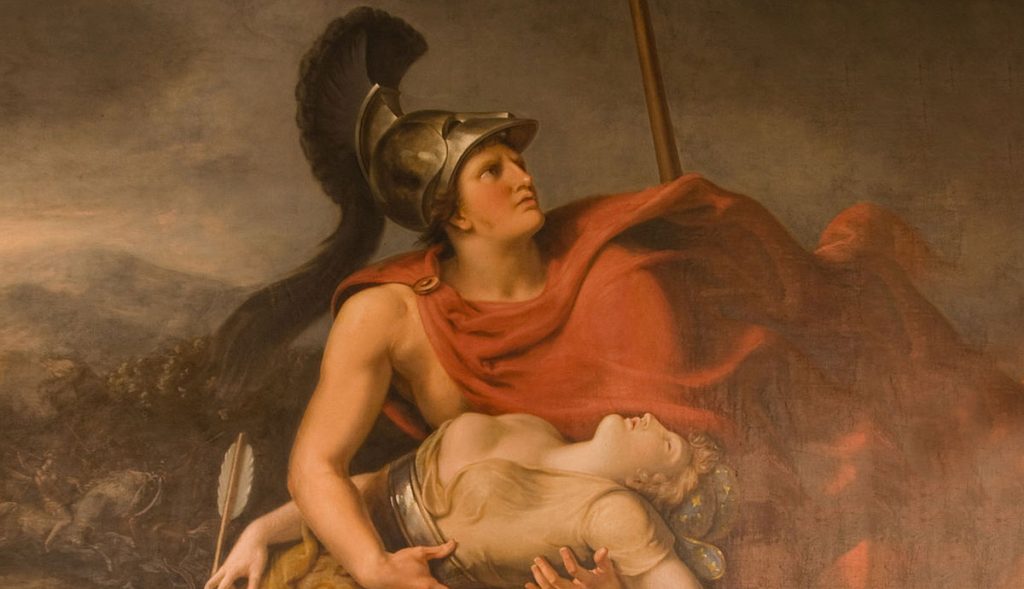
An Amazon queen rides into Troy and nearly stops the Greeks’ greatest killer. In the heartbeat between spear and silence, the myth flips Greek expectations of man and woman—and then makes us watch Achilles flinch.
The Scene We’ve Inherited
The Iliad ends before Penthesilea arrives. Her story lives in the lost epic Aethiopis (summarized later) and in vivid Greek vase paintings, then gets retold by Quintus of Smyrna and Roman writers. The essentials:
- After Hector’s death, the Amazons come to aid Troy, led by Queen Penthesilea.
- She challenges the Greeks; in single combat she faces Achilles.
- Achilles kills her. Seeing her face as he removes her helmet, he is struck by a shock of desire or pity—sources differ.
- Thersites mocks him for “falling in love with a corpse”; Achilles kills Thersites in fury and is ritually purified.
The duel is quick; the aftershock is long. Around that small narrative the ancient world argued about courage, beauty, shame, and who was allowed to embody them.
What the Amazons Meant to the Greeks
The Amazons are not just women with spears. They are a deliberate inversion of Greek social order:
- Outside the oikos: Greek ideals placed women inside the household, managing weaving and kin. Amazons live outside walls, on horses, at war.
- Reversed παιδεία: Greek men trained for war; Amazon women did. The culture is a mirror that reverses gender roles.
- Border beings: They dwell at the edges (Scythia, the Black Sea)—mythic geography for the “not-quite-us.”
In art and storytelling, Amazons test the line between order and wildness. They let Greek audiences stage a forbidden question: what if a woman had a man’s social license?
Penthesilea: A Queen With Tragic Weight
Penthesilea is not an anonymous Amazon. She arrives with a motive: in several versions, she has accidentally killed her sister in a hunt and seeks an honorable death to end her shame. That frames her as a tragic peer to male heroes. She is not a curiosity; she is a character with aidōs (honor-shame sensitivity), aretē (excellence), and a warrior’s desire for a worthy end.
Already the story bends norms: Greek tragedy reserves this burdened interiority for men and royal women inside houses; Penthesilea bears it onto the battlefield.
The Duel: Gender Meets Glory
On the plain, the categories collide:
- Achilles stands for andreia—courage, prowess, the male-coded virtue that anchors the Greek city’s defense and identity.
- Penthesilea performs andreia too—publicly, competently, in front of armies. She is a woman enacting the male ideal without apology.
The myth forces a binary culture to watch a woman do the thing that defines its men. And she nearly wins. Vase painters often show her spear grazing Achilles, her stance balanced and credible. Even when she dies, the composition grants her parity—eye to eye with the Greek terror.
That staging isn’t accidental. It lets artists register both fascination and alarm. The Amazon is everything Greek ideology excludes—and everything it secretly admires.
The Shock After the Kill
The decisive transgression is not that Penthesilea fights; it is that Achilles feels.
When he lifts the helmet and sees her face, something breaks open—variously glossed as desire, compassion, or stunned recognition. The most provocative reading (the one Thersites voices and the Romans amplify) is erotic: Achilles, avatar of controlled killing, experiences eros at the moment of lethal victory.
Why is that shocking?
- Eros trespasses on andreia. Battle is supposed to be clean: blow, boast, move on. Achilles pauses and is moved—by a woman warrior, by beauty, by the ruin he caused.
- The male gaze is unsettled. He does not look at a veiled bride in a symposion song; he looks at a fallen enemy who has just matched him in andreia. The gaze has to reconcile desire with respect.
Ancient storytellers register the scandal by hiring a stand-in for the jeering chorus: Thersites, the anti-hero, mocks Achilles for loving a corpse and loving a woman he has just killed. Achilles’ response—killing Thersites—is both a cover-up and a confession. He silences the voice that says the quiet part out loud. Then he submits to purification, acknowledging a moral rupture that war alone cannot excuse.
The ritual matters. Achilles seeks cleansing for killing a Greek, but also, symbolically, for crossing emotional wires the code of masculinity tries to keep separate: desire, pity, and grief inside the theater of glory.
What the Myth Upends—and What It Reinforces
It Defies
- Monopoly on courage. Penthesilea’s presence proves courage is not sex-locked. She enacts the warrior ideal as cleanly as any man.
- Emotional denial. Achilles’ moment denies the fantasy that warriors are unfeeling machines. The greatest killer is capable of vertigo at beauty and loss.
- One-way gaze. The scene grants the fallen woman subject-status—her face can move the story’s prime mover.
It Reasserts
- Male victory. Penthesilea dies; the Greek line holds. The myth permits transgression only within a frame that is ultimately conservative.
- Containment by shame. Thersites’ ridicule and Achilles’ subsequent purification pull the moment back into acceptable lanes: ridicule the softness, ritually scrub the stain.
- Mythic geography. Amazons remain “elsewhere,” restoring the everyday boundary between Greek women and public combat.
The power of the story is that it lets the defiance happen—clearly, memorably—before it reinscribes the social line. The friction is the point.
Athens Paints the Problem
Attic vase painters of the 6th–5th centuries BCE loved Amazonomachies (Greek-Amazon battles). On cups and amphorae:
- Amazons are armed like hoplites, sometimes in Persian dress—another way to say “other.”
- Penthesilea’s duel with Achilles shows mutual poise: symmetrical bodies, spears leveled, her gaze locked with his.
- In several famous scenes, Achilles’ eyes widen at the un-helmed queen—a visual shorthand for the jolt the texts narrate.
These images circulated in symposia where elite men reclined, drank, and debated virtue. The cups function as philosophical mirrors: What happens to our ideals if a woman carries them better than a man? The paintings don’t answer; they keep the question refilling.
Why Thersites Has to Die
Thersites always speaks the socially dangerous truth in the ugliest way. Here he makes two accusations:
- Achilles feels erotic desire for a dead enemy (a taboo).
- Achilles feels that desire for a woman who performed male excellence (a deeper taboo).
Killing Thersites punishes the insolence—but it also spares Achilles from having to articulate the complexity of his feeling. In that sense the killing is a dodge. The later purification is the honest moment: even heroes know there are lines, and he crossed one, whether in deed or in heart.
The pair—murder and cleansing—draws the contour of Greek masculinity: public honor first; private repair later.
Penthesilea as Double of Hector—and of Achilles
If Hector is the noble defender Achilles must kill to become the poem’s fatal god, Penthesilea is a second mirror:
- Like Hector, she is a worthy foe whose death diminishes the glory of the killer by making him feel.
- Like Achilles, she chooses a short life with undying renown over a safe one. Her quest for honorable death echoes his own choice.
That doubling unsettles the gender line again. Penthesilea doesn’t just “fight like a man”; she shares the hero’s tragic calculus, the very nerve of Greek epic.
Reception: How Later Ages Read the Glance
- Quintus of Smyrna dramatizes the duel and the gaze, leaning into pathos.
- Roman poets (and scholiasts) amplify the necrophilia slander to heighten scandal and moralize Achilles.
- Medieval and Renaissance retellings often soften the erotic charge and emphasize chivalric honor: the knight is moved by the lady warrior’s beauty and valor.
- Modern readers reclaim Penthesilea as a feminist icon or interrogate Achilles’ violent desire. Kleist’s tragedy makes the attraction explicit and catastrophic, turning the myth into an explosion of eros and death.
Each era picks its anxiety: sexual transgression, martial ethics, gendered excellence. The myth is elastic because the glance can mean pity, love, horror, or self-recognition.
What the Myth Still Asks Us
- Who gets to own excellence? If excellence is genuinely human, exclusive codes tremble. The Amazon asks why some bodies are barred from the stage on which they can plainly excel.
- What do we do with mixed feelings in violent systems? Achilles’ moment names a reality soldiers know: battle scrambles categories—enemy/beautiful, victory/loss, pride/shame.
- Can a culture admire what it forbids? Greek art says yes—and shows the cost: the admired figure is destroyed, the admirer is tainted and must be washed.
A Clearer Ending Than the Poets Gave
Penthesilea dies, but not as a “lesson” against women in arms. She dies as a hero, and the story’s most disciplined man is the one who cannot keep the world in its boxes when he meets her. That is the defiance. The myth lets a woman occupy the center for a breathless instant—and makes the greatest male hero blink.
If you strip away the later jeering, the image that stays is simple: two warriors, equal in poise, catching sight of each other’s humanity at the exact pivot of death. In a culture that drew hard lines, that vision was dangerous—and irresistible.
That’s why the painters kept drawing it, and why we keep returning to the scene. The glance refuses to die.

support our project
At History Affairs, we believe history belongs to everyone.
donateYour contribution helps us keep this global archive open, free, and growing — so people everywhere can learn from the past and shape a better future.
know the present
Defense Tech Needs the State, Not Less of It
Trump Era or The New Imperial Age
America First, Venezuela, and the Trap of Old Habits
Why the AI Race Has No Winner
reading more
Kashmir: A Valley in Limbo
The Second Reform Act of 1867: What Really Changed in Britain
Crassus and the Catastrophe at Carrhae
Svalbard: From “Cold Coast” to Doomsday Vault
Montesquieu, Rousseau, and the Evolution of Social Institutions
Edgar Allan Poe: The Mastermind Behind Modern Horror
Who Gets to Call It Art? Inside the “Artworld” Theory
Geoffrey of Monmouth: The Man Who Made a King
Roman Senate: Backbone —and Burden—of a World-Conquering Republic
Ulysses S. Grant: Shy Farm Boy, Reluctant Soldier, Relentless Leader
Why the AI Race Has No Winner
Defense Tech Needs the State, Not Less of It