
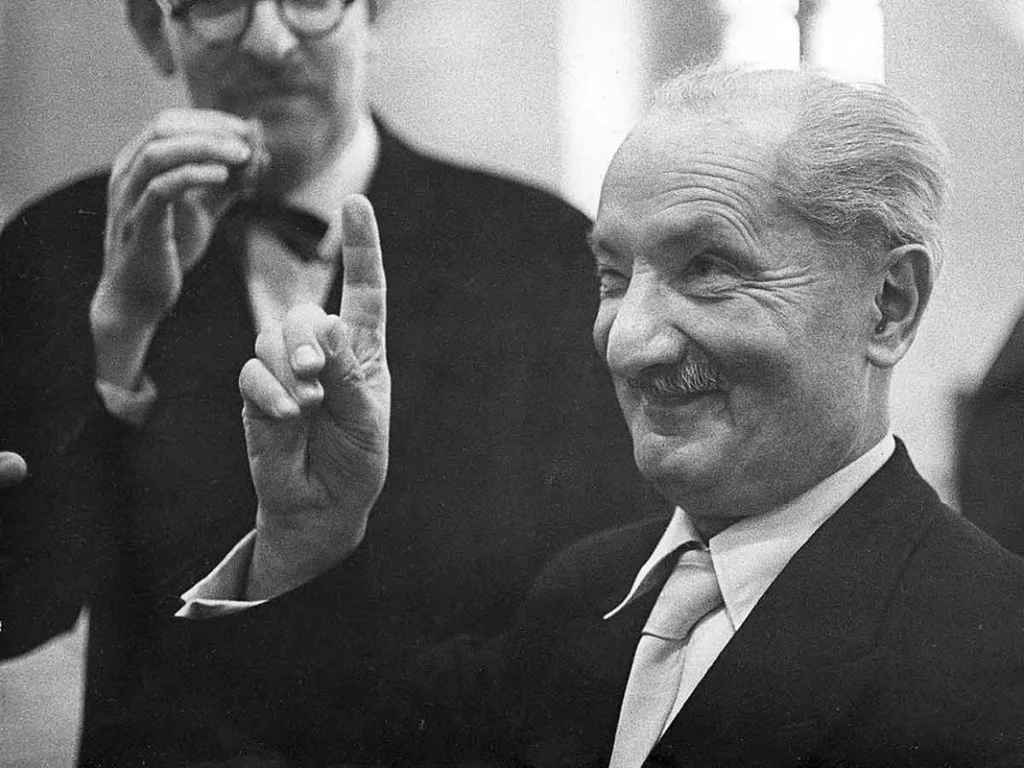
Martin Heidegger is one of those thinkers you can hardly ignore. Even if you’ve never read a line of his work, you’ve probably felt his influence—through existentialism, phenomenology, hermeneutics, or through the many philosophers and writers who took him seriously (or spent their careers arguing with him).
He is both towering and tainted: the author of Being and Time, one of the most important philosophical books of the 20th century—and a man whose name is permanently marked by his involvement with National Socialism. His story is the story of both brilliance and a very public failure of judgment.
From Village Altar to University Desk
Heidegger was born in 1889 in the small village of Messkirch in Baden, in southwest Germany. His childhood world was thoroughly Catholic. His father worked as a sexton in the local church, and young Martin grew up around bells, liturgy, and village piety.
Gifted and serious, he earned a scholarship and went off to secondary school in Konstanz. The natural path for such a boy, given his background, was the priesthood. In 1909 he entered a Jesuit seminary. But his stay was brief: health problems forced him to leave.
That detour ended up changing his life. Around this time, he encountered a book that would redirect his future: Franz Brentano’s On the Various Meanings of Being According to Aristotle. Heidegger later said this work woke up his philosophical curiosity. Instead of asking only what the Church teaches, he began asking a more basic, disquieting question: what does it mean to be?
He enrolled at the University of Freiburg, initially studying theology and scholastic philosophy. But he slowly drifted away from formal theological studies and toward philosophy proper. There he met the two thinkers who would shape his development most strongly: Edmund Husserl, the founder of phenomenology, and Heinrich Rickert, a key figure in Neo-Kantian philosophy.
Other voices echoed in his mind as well: Aristotle, Søren Kierkegaard, and Wilhelm Dilthey. The mix of ancient metaphysics, Protestant existential anxiety, and historical understanding would all find their way into his mature work.
In 1913, Heidegger completed his doctorate with a dissertation on psychologism in logic, later published as The Doctrine of Judgment in Psychologism. Two years later he finished his habilitation—a second, more demanding qualification for teaching at German universities—on the medieval theologian John Duns Scotus.
By this point, his path to the priesthood was behind him. He gradually broke with Roman Catholicism, and under the influence of Protestant thinkers like Martin Luther and John Calvin, he moved further away from the Church of his childhood. In 1917 he married Elfride Petri, a Lutheran, sealing not only a personal but also a religious shift.
The Rumor of a “Hidden King”
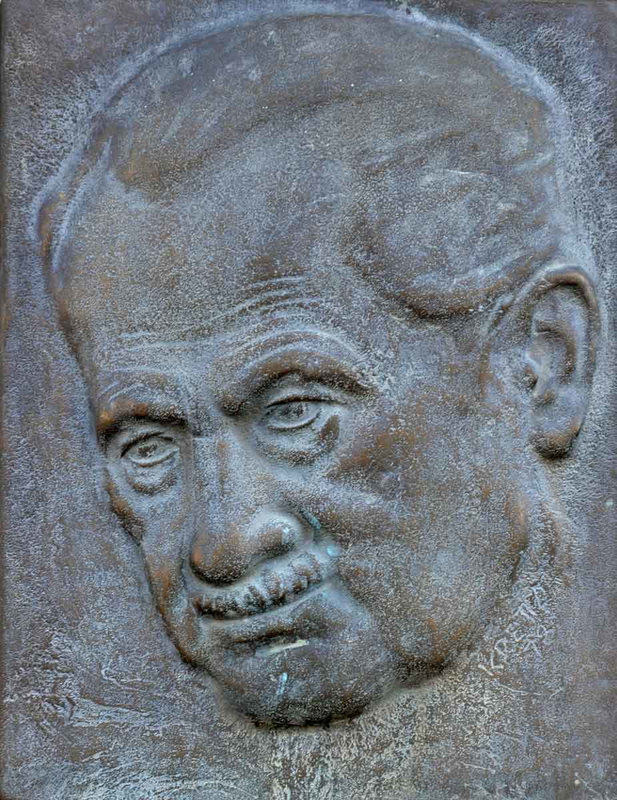
After serving briefly as a soldier near the end of World War I, Heidegger returned to Freiburg and began lecturing. From 1919 to 1923, he taught as an assistant to Husserl. Even before he was widely published, whispers about him spread in academic circles. His lectures were intense, demanding, and electrifying. Students felt they were hearing something entirely new.
In 1923 he was appointed associate professor at the University of Marburg. There, his reputation exploded. One of his students was a young woman named Hannah Arendt, who would later become one of the most important political thinkers of the century. Looking back, she described how students spoke of Heidegger as a “rumor of a hidden king” in philosophy—a kind of underground sovereign of thought whose fame moved ahead of his publications.
Arendt and Heidegger began an affair in 1925, a secret relationship that lasted about four years. Both were careful to hide it—Heidegger was married, and their professional positions were delicate—but their correspondence eventually came to light decades later, revealing the emotional complexity behind one of the most famous teacher–student relationships in philosophy.
Marburg was also the setting for Heidegger’s intellectual breakthrough. In 1927, he published his magnum opus, Being and Time. The book was dense, difficult, and unlike anything else at the time. In it, Heidegger tried to reopen the question of Being itself—not as an abstract puzzle, but through an analysis of human existence (Dasein), with its anxieties, everyday routines, and confrontation with death.
Being and Time made him a star. Almost overnight, he was no longer just Husserl’s gifted assistant but a leading philosopher in his own right. Phenomenology, thanks to Heidegger, took a new turn—toward existential questions, finitude, and the meaning of everyday life.
Rector, Party Member, and Permanent Stain
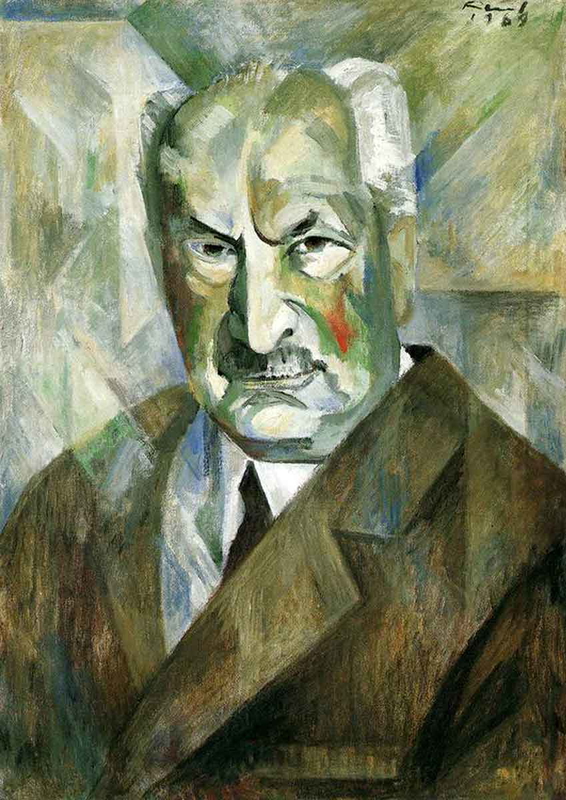
Success brought power—and with it, the worst decision of his life. In 1928, after Husserl retired, Heidegger took over his chair at the University of Freiburg. In 1933, as the Nazi Party seized control of German institutions, Heidegger was elected rector of the university.
He joined the Nazi Party and, for a time, tried to work within the new regime. This period is the most troubling part of his biography. However nuanced one tries to be, the fact remains: he publicly aligned himself, at least initially, with National Socialism.
The honeymoon did not last. The Ministry of Education ordered him to appoint Party members as deans in certain departments. Heidegger resisted, and within a year he resigned as rector. Later he would claim disillusionment with the regime and say that he was watched and censored.
After World War II, the Allied denazification process investigated his case. He was banned from teaching for a time, but eventually classified as a Mitläufer—a “follower,” one of the lowest levels of political guilt—so the harshest penalties were lifted.
Still, the damage to his reputation was permanent. For many, the question was no longer just, “What did Heidegger say about Being?” but also, “How seriously can we take a philosophy whose author once marched, however briefly, in line with a murderous ideology?”
Late Years, Final Words, Lasting Influence
In 1950, Heidegger was allowed to resume teaching at Freiburg. He never again fully stepped into the academic spotlight the way he had in the 1920s, but he continued to lecture, write, and revise his earlier thoughts.
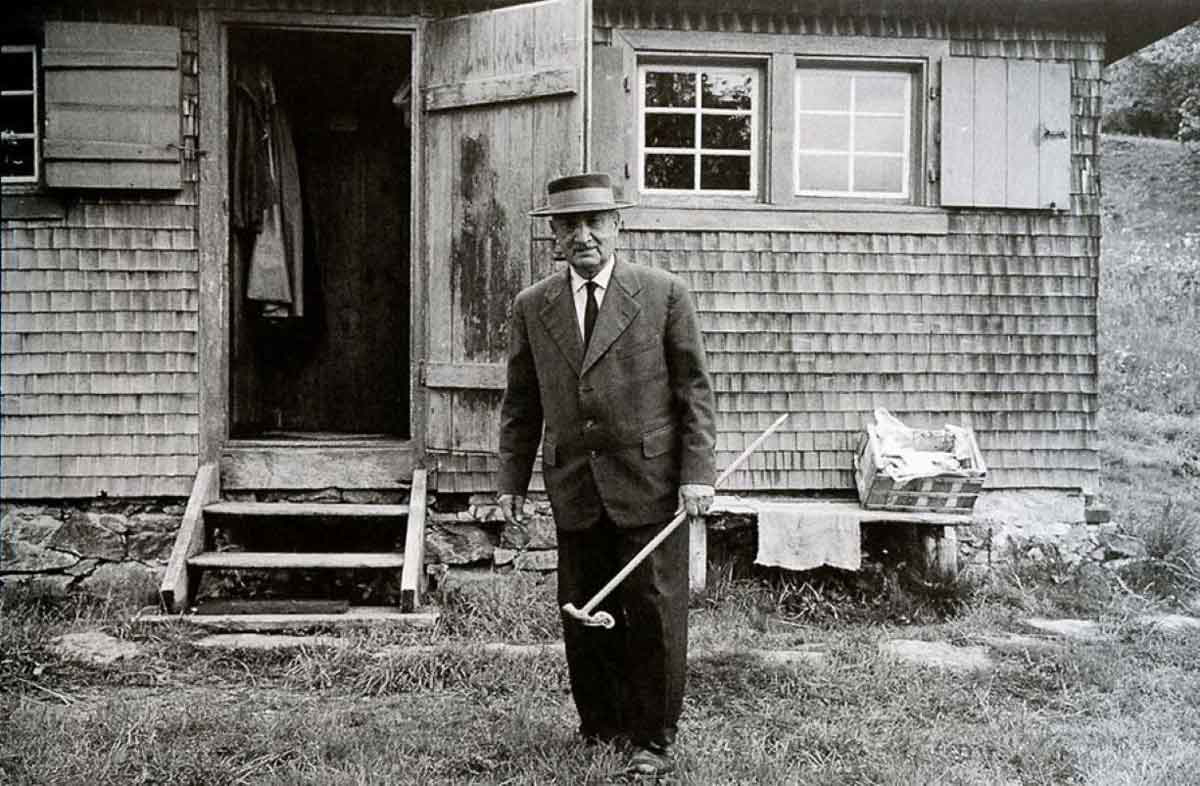
He spent much of his time in his simple hut in the Black Forest, where he liked to present himself as a thinker rooted in soil, seasons, and the rhythms of rural life. There, he developed later ideas on technology, language, and “dwelling” that would influence fields from literary theory to environmental philosophy.
In 1966, he gave a long, now-famous interview to the German magazine Der Spiegel, conducted by Rudolf Augstein and others. Heidegger agreed that it should only be published after his death. When it finally appeared, under the title “Only God Can Save Us,” it became one of the key texts for understanding how he himself viewed his political past and the crisis of the modern world.
Before his death in 1976, Heidegger oversaw plans to publish his collected works: more than a hundred volumes of lectures, essays, and notes. He was buried in Messkirch, not far from the church where his father had once worked and where his own life had begun.
His legacy remains divided. On the one hand, he is a foundational figure for phenomenology, existentialism, hermeneutics, and much of continental philosophy. On the other, his flirtation with Nazism remains a deep moral wound that can’t be excused or ignored.
Perhaps the honest way to read Heidegger today is with both admiration and suspicion: to recognize the power of his questions about Being, time, and human existence, while never forgetting how easily a brilliant mind can go astray when it mistakes a political movement for a historical “destiny.”

support our project
At History Affairs, we believe history belongs to everyone.
donateYour contribution helps us keep this global archive open, free, and growing — so people everywhere can learn from the past and shape a better future.
know the present
Defense Tech Needs the State, Not Less of It
Trump Era or The New Imperial Age
America First, Venezuela, and the Trap of Old Habits
Why the AI Race Has No Winner
reading more
Heracles and the Cretan Bull: The Seventh Labor
Origin of Merlin: Prophet and Wizard
Tracing Our Earliest Path: From Hominids to Matricentric Societies
Ulysses S. Grant: Shy Farm Boy, Reluctant Soldier, Relentless Leader
Top 6 Latin American Writers in History
Why Athens Exiled Its Most Popular Politicians
Louis XIV: The Sun King’s Long Reign
France and the First Thunder of the Mongols
The Harpies: Winged Agents of Vengeance
The Secret of the Black Chamber: How Letters Were Spied On in 18th-Century Europe
Ancient Greek Wisdom Back to Europe through Crusades
The Roman-Tamil Trade: How Pepper, Pearls, and Gold Shaped Southern India