
In the early nineteenth century, learning didn’t just happen in schoolrooms and study halls. It happened around card tables and on game boards too.
As Sir Walter Scott joked in Waverley (1814), “the history of England is now reduced to a game at cards, the problems of mathematics to puzzles and riddles.” Behind that line was a real trend: an explosion of educational card, dice, and board games designed to make learning feel like play. This boom grew out of new ideas about childhood and education, especially those inspired by John Locke a century earlier.
And although women were largely barred from universities and serious scholarly careers, this new industry quietly opened a door for them. Game design became one of the few respectable ways women could combine creativity, intellect, and income.
Nowhere did they leave a bigger mark than in the world of music.
When Games Became Lessons

By the late 1700s and early 1800s, “instructional” games were everywhere. They promised to teach geography, history, science, language, and more, all through familiar formats: racing boards, spinners, dice, and cards.
One of the standout early designers was Margaret Bryan, who ran a girls’ school in Blackheath, near London. A science writer with a special love for astronomy, Bryan created the board game Science in Sport, or the Pleasures of Astronomy with the publisher John Wallis.
It was modeled on the classic “Game of the Goose” style race game (think of something like Chutes and Ladders). Players spun a teetotum, moved their pieces around the board, and landed on spaces that illustrated scientific concepts—with explanations in a rule booklet. But the board also scolded bad behavior. One square showed “The County Gaol… for those who attend to the motion of Billiard Balls, more than to the motion of the Planets,” another simply depicted “a blockhead.” Land there, and you’d lose a turn or be sent back.
Other women followed similar paths:
- Alicia Catherine Mant, a children’s author, designed another astronomy-themed board game.
- Elizabeth Rowse, a poet and schoolteacher, created games like A Grammatical Game, in Rhyme, by a Lady (1802) and Mythological Amusement (1804).
These projects were more than cute diversions. They were ways for women to publish, earn money, and work intellectually in a culture that told them serious study was not their place.
support our project
At History Affairs, we believe history belongs to everyone.
Your contribution helps us keep this global archive open, free, and growing — so people everywhere can learn from the past and shape a better future.
Why Music Was the Perfect Playground
Among the middle and upper classes, music was considered a “female accomplishment.” Girls were encouraged—even expected—to learn the piano, sing, and read music. Mothers, governesses, and schoolmistresses did most of the teaching.
But music theory—rules of notation, rhythm, harmony—could be dry and overwhelming when taught by rote. At the same time, it was rule-bound, systematic, and full of recognizable patterns. That made it perfect for turning into games.
If you wanted to teach a child the difference between note values, key signatures, or chord progressions, why not use a board, counters, and a bit of competition?
This is where one of the most fascinating figures appears: Anne Young.
More reading


Anne Young’s Musical Games
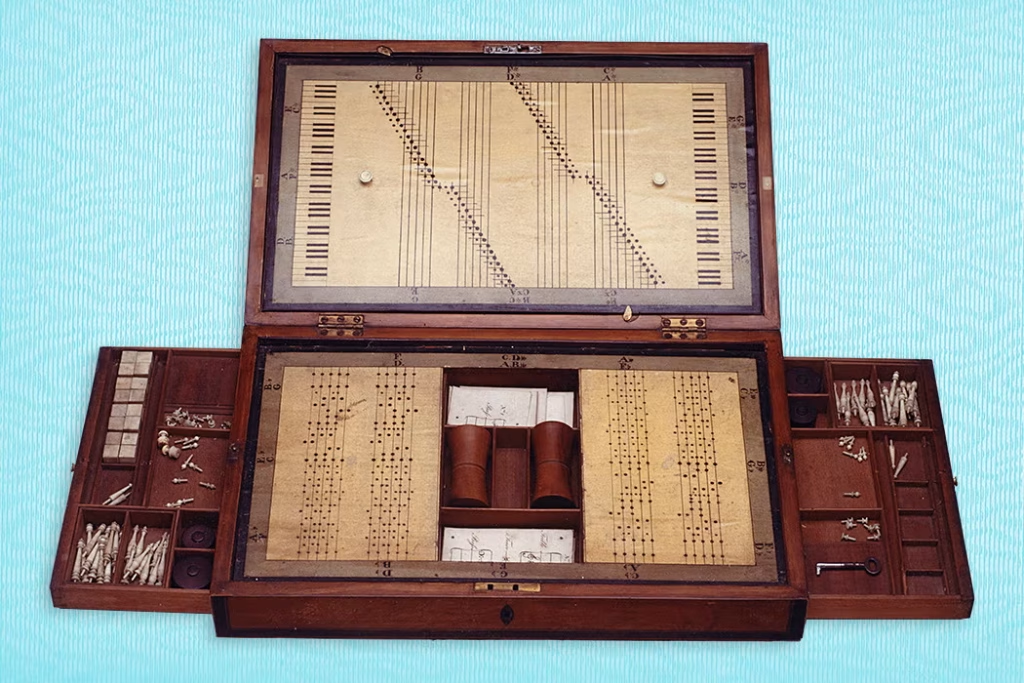
In 1801, Anne Young, an Edinburgh-based pianist and music teacher, did something remarkable: she received a royal patent for a set of Musical Games designed to “render familiar and impress upon the memory, the fundamental principles of the science of music.”
It was:
- The first British patent ever granted for a game.
- The only patent that year awarded to a woman.
Two years later, now married and known as Mrs. Gunn, she published a 250-page book titled An Introduction to Music. It wasn’t a standard music theory manual. Instead, it explained musical fundamentals through the rules of her games. The treatise is divided into seven sections, each tied to a different set of games, and together they outline twenty-two different game types.
The games themselves were luxurious objects. Surviving sets in museums and private collections show:
- Boards made from mahogany
- Nearly 200 individual pieces—pins, plates, dice, counters—carved from ivory and ebony
Originally sold for seven guineas (more than a laborer’s yearly wages), they were clearly targeted at wealthy households.
Unlike earlier musical dice games, which encouraged players to generate random musical compositions, Young’s Musical Games were all about theory:
- Some games involved racing up and down tracks, reinforcing note reading and pitch relationships.
- Others rewarded correct answers with points tracked via ivory counters.
A child who worked through the sequence of games would cover everything from basic notation to chord resolution and modulation. In other words, this wasn’t a toy that happened to be educational—it was a structured curriculum disguised as play.
“So Clever and Ingenious”
Anne Young’s invention didn’t disappear after her lifetime. Nineteenth-century musical journals kept bringing it up, sometimes prompted by readers curious about her work or intrigued by the glowing praise of her husband, John Gunn, a respected music pedagogue. He insisted he had admired the games’ merits before he even knew who had invented them—an attempt to show his praise was unbiased.
In 1907, nearly a hundred years later, the games resurfaced again in an essay called “Games of Music” by Bertha Harrison, published in The Musical Times. Harrison—very likely the same Ethel Bertha Harrison known for her anti-suffrage activism—was interested in music history and children’s education.
She called Young a woman “possessed of an uncommon order of mind” and described the Musical Games as “so clever and ingenious, so full of nice detail, that all the music games of the present day seem poor in design and clumsy in execution in comparison with it.”
But then came the twist.
Harrison noted that musical games invented by women tended to be “very complicated and extraordinarily full of detail,” while those by men were usually simple and often adapted from other games. From this, she suggested two possible explanations:
- Women might be more original than men in this area, or
- Women get so caught up in details that they “cannot see the wood for the trees.”
In other words: even when acknowledging women’s impressive work, she fell back on the stereotype of the overly detailed, “fussy” female mind.
As critic Naomi Schor and others have pointed out, this idea—that women are meticulous but somehow limited by their attention to detail—has been used for centuries to undermine female intelligence and creativity.
A Hidden Tradition of Women Game Designers
Harrison’s stereotypes aside, the nineteenth century was full of clever music games designed by women.
A few examples:
- At the 1851 Great Exhibition in London, Abelinde Prince showcased Gioco di Euterpe (“Game of Euterpe,” after the Greek muse of music), aimed at helping beginners understand note values and timing.
- The editor of The Girl’s Own Book (1869) described a game invented by an anonymous woman, called “Sir Samuel Semibreve,” which taught sight-singing and could be purchased from a Middlesex music shop.
Across the Atlantic, women were filing patents of their own:
- In 1895, Abbie T. Hays, who ran a music school in Wichita, Kansas, patented a “musical game device” that used pictures to teach notation by spelling simple words with note names (like B-A-G or B-E-E).
- Later that year, Sarah W. Featherstone, a schoolteacher in Toledo, Ohio, patented Nota Bene, a spinning-wheel game designed to teach rhythm.
- In 1897, Evelyn Fletcher of Toronto filed both Canadian and US patents for a Music Block Game. Her “Fletcher Music Method” went on to win endorsements from big names like John Philip Sousa and Hugo Riemann and became popular with schoolteachers.
When you dig into nineteenth-century patent records, a striking pattern emerges: you’re more likely to find music games designed by women than by men. On this point, at least, Bertha Harrison was right.
From Mahogany Boards to Music Apps
Today, the idea of using games to teach music feels obvious. Children learn rhythm from clapping games, notation from apps, and coordination from rhythm-based videogames.
Modern examples include:
- Instrument-based games like Guitar Hero or Rock Band, which teach timing and coordination.
- Online platforms like ToneGym, Solfege Story, or Chet – Ear Training, which gamify ear training and theory drills.
These tools live on screens instead of mahogany boards, and their pieces are pixels instead of ivory. But they still belong to the same lineage: using play to unlock the “rules” of music.
What often goes unmentioned is just how deeply this tradition was shaped by women. From Anne Young’s patented Musical Games to the countless schoolteachers, governesses, and music instructors who invented clever teaching devices, women were not just users of educational games—they were their leading creators.
The next time a music app or game makes theory feel easier, it’s worth remembering: this is not a new idea. It’s the digital echo of a long, inventive, and surprisingly female history.

support our project
At History Affairs, we believe history belongs to everyone.
donateYour contribution helps us keep this global archive open, free, and growing — so people everywhere can learn from the past and shape a better future.
know the present
Defense Tech Needs the State, Not Less of It
Trump Era or The New Imperial Age
America First, Venezuela, and the Trap of Old Habits
Why the AI Race Has No Winner
reading more
Pope Leo X Who Helped Ignite the Reformation
Machiavelli, Luther, and the Rise of Modern Moral Thought
Nikolay Gogol: From Ukrainian Tales to Russian Satire
Petra: The Rose-Red City and the Scented Road
“Crazy Judah” and the Railroad That United America
France and the First Thunder of the Mongols
Absinthe: From Green Fairy to Moral Panic
Decolonization and Asymmetric Warfare
New Year, Old Books: A Tradition of Book Giving
Constantine and the Christian Empire
Manichaeism: The Forgotten Religion That Rivaled Early Christianity
The Spotlight Effect: Why You Feel Watched (And How to Stop It)