
I went into King and Conqueror (BBC One) expecting the usual trade-off: a bit of historical compression, some invented dialogue, maybe a composite character or two—fine. The period it covers, the decades leading up to 1066, is a gift to dramatists. Compared with earlier English history, it’s unusually well documented in narrative sources. The reign of Edward the Confessor and the rise and fall of Harold II are already packed with power politics, rival factions, shifting loyalties, and genuinely high-stakes decisions.
Better still (for a writer), the sources don’t always line up neatly. Historians still argue about motives, timing, and even what certain players were trying to do. That messiness isn’t a problem. It’s fuel. The contradictions and gaps are exactly where a smart script can build plausible scenes without betraying the record.
And that’s what makes this series so frustrating: it doesn’t lean into the suggestive uncertainty. Instead, it swaps out things we actually know happened for things there is no evidence for—and not just “maybe” evidence, but the kind of inventions that should never have made it past the first draft.
Take the show’s most jaw-dropping move: Edward killing Queen Emma in a violent rage, using his crown. Whether Edward was emotionally dependent on his mother is debatable; that part belongs to interpretation. But murdering her like that is a different category. It’s not “dramatic license.” It’s a total break with what the period’s documentation makes believable.
Or look at the way the show handles ritual and space—where medieval politics often lived. Coronations in this era weren’t private, cramped affairs staged in a little chapel-like room that looks interchangeable from one king to the next. These were public, symbolic events tied to specific places and elaborate forms—statements about kingship, legitimacy, sacred power, and national identity. Even when a show compresses, it can still convey scale, choreography, and meaning. Here, the visual language shrinks the whole thing into something oddly small and modern.
Then there’s the Hastings angle: the series toys with the idea that Harold loses because he’s betrayed by a major English faction—Mercian forces under an earl conveniently positioned as the story’s Judas. This is the kind of twist that sounds punchy in a writers’ room, but it’s not supported by evidence in the way the show implies. It takes a complicated political landscape and reduces it to a clean, soap-friendly backstab.
So it’s not merely a question of “some errors.” It’s a pattern: replacing recorded events with invented ones that change the moral and political logic of the era.
The bigger problem isn’t the mistakes—it’s the modern costume under the chainmail
Even when the show isn’t outright fabricating, it repeatedly drags the 11th century into a contemporary mould. The result isn’t “accessible.” It’s patronising.
Harold and William are styled like modern “hands-on dads,” doing a kind of domestic intimacy that feels designed to signal relatability rather than reveal anything about medieval elite life. Women are written as political operators in a recognisably modern register—less a window into medieval power and more a reassurance that the show knows what today’s viewers are supposed to applaud. A count turns into a foodie celebrity-chef character, complete with swagger and culinary flourish that belongs to a gangster film, not Flanders.
None of this helps the audience understand the strangeness of the medieval world—the assumptions about God, legitimacy, oath-binding, sacred kingship, kinship networks, honour, fear, fate. Those are the things that make the period dramatic in the first place.
And that strangeness is exactly what good medieval filmmaking respects.
Three better ways to film the Middle Ages
If you want models for how to make medieval history work on screen without flattening it into modern realism, there are at least three approaches that show what’s possible.
1) Build a medieval world visually, not just conversationally
One of the most broadly popular examples is El Cid (1961). Part of why it works is surprisingly simple: many scenes are almost tableaux—bold, composed, richly coloured, like illuminated manuscript images brought to life. The pacing allows the viewer to sit inside the world.
Even more important: it doesn’t pretend to be doing modern “this is what really happened” realism. It cleaves to the legend as the medieval tradition shaped it. That legend isn’t fully reliable history—but it has emotional power and coherence on its own terms. It doesn’t need to bolt on a modern ideological framework to feel meaningful.
2) Accept that “humdrum realism” can’t carry medieval belief
The deeper issue is that medieval sources often aren’t interested in individual psychology the way modern drama is. People appear as types: the king, the saint, the oath-breaker, the traitor, the faithful servant, the sinner. And medieval life is saturated with a worldview where the supernatural is not a metaphor—it’s part of the furniture of reality.
That’s why stylisation often succeeds where gritty realism fails.
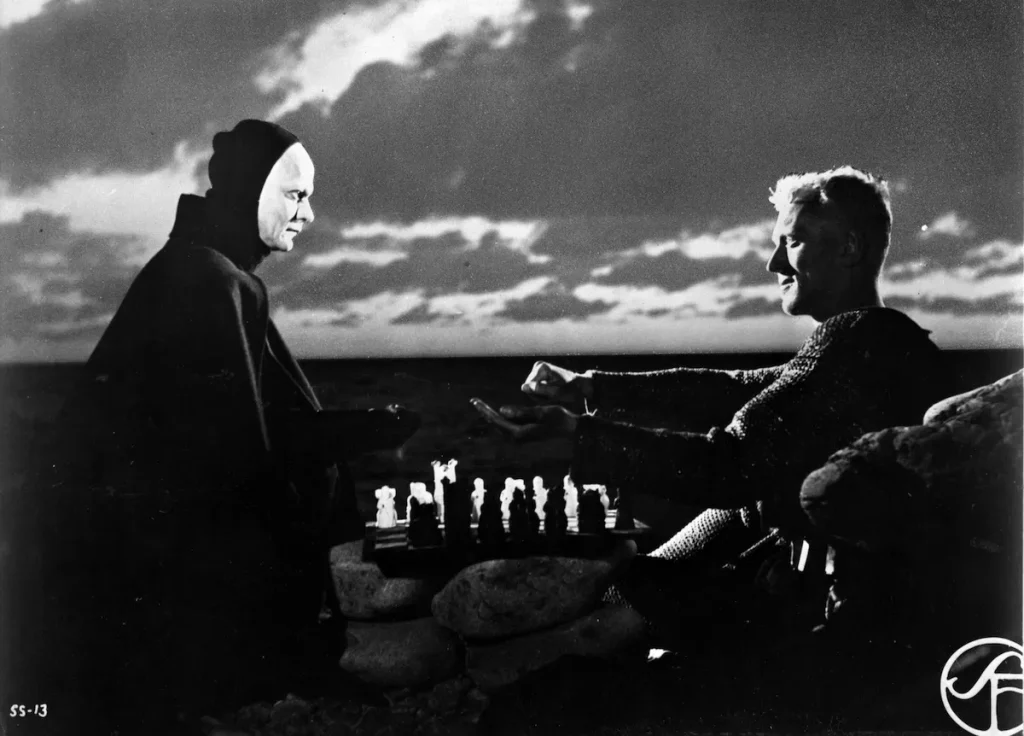
Ingmar Bergman’s The Seventh Seal (1957) doesn’t try to recreate the Middle Ages as a museum set with naturalistic banter. It gives you an unforgettable image: a returning crusader playing chess with Death during the Black Death. The film is built out of images like that—visions that feel closer to medieval art and medieval fear than any attempt at “authentic” mud and yelling.
3) Use episodic structure and faith as the engine
Andrei Tarkovsky’s Andrei Rublev (1966) goes further. It’s not a tight modern plot machine; it’s a sequence of episodes. That’s exactly why it works. The Middle Ages are not treated as a backdrop for contemporary character drama. The central subject becomes faith, expressed through images and crises rather than modern psychological exposition.
The concluding idea—success born from throwing oneself on mercy, doing what you don’t fully understand and surviving by belief—fits medieval spirituality far better than a string of modern-style personal arcs dressed in period clothing.
What King and Conqueror tried to do instead
The series seems to assume viewers won’t tolerate stillness, ceremony, or strangeness. So it speeds up, simplifies, modernises, and spices the stew with invented shocks. The end result feels like it’s trying to mash together reality-TV social vibes with soap opera rhythms, then drop a helmet on top and call it medieval.
But the 11th century doesn’t need that makeover. The sources already give you ambition, peril, betrayal, legitimacy crises, and looming catastrophe. What you need is the courage to show the world as unfamiliar—and trust the audience to follow.
Because if you’re going to dramatise 1066, the last thing you should do is make it feel like EastEnders in armour.

support our project
At History Affairs, we believe history belongs to everyone.
donateYour contribution helps us keep this global archive open, free, and growing — so people everywhere can learn from the past and shape a better future.
know the present
Defense Tech Needs the State, Not Less of It
Trump Era or The New Imperial Age
America First, Venezuela, and the Trap of Old Habits
Why the AI Race Has No Winner
reading more
Henry VII: The Overlooked Architect of the Tudor Dynasty
Who Were the Edomites? The Long Rivalry Between Israel and Edom
A Short History of Ball Games: From Olmec Rubber to Japanese Kemari
Imperial Cult: When Roman Emperors Canonized
Roman Voyages to Indo-Parthian India
Ancient Medicine and the Four Humors
Petra: The Rose-Red City and the Scented Road
New Year, Old Books: A Tradition of Book Giving
How Rome Educated Its Slaves
Manichaeism: The Forgotten Religion That Rivaled Early Christianity
Augustus: First Emperor of Rome
How the Mexican-American War Forged the American West and Shaped a Nation