When people hear the name Leonardo da Vinci, they usually think of the Mona Lisa or The Last Supper. But behind the paintings was a restless engineer who spent his life sketching machines the world wasn’t ready to build yet.
If the Renaissance was Europe waking up, Leonardo was the guy who rolled over, grabbed a notebook, and started drawing helicopters and tanks before breakfast.
Most of his inventions stayed as ink on paper for centuries. But those pages reveal how he thought, what he feared, what he hoped for—and just how far ahead his imagination really was.
A Mind That Wanted to Know Everything
Leonardo wasn’t “just” an artist who dabbled in science. He was obsessed with how things worked.
In his notebooks—his codices—you find sketches and notes not only about painting but about:
- anatomy
- flight and bird wings
- geometry and mathematics
- optics and light
- geology and water flow
- architecture and fortifications
He didn’t separate art and engineering in his head. Studying a muscle, a river, or a bird’s wing was part of the same project: understanding nature well enough to imitate it or improve it.
He recorded all of this in tiny, dense script, written right-to-left (mirror writing). People debate whether that was a security measure or just something that felt natural to a left-hander. Either way, it had a useful side effect: his notes were harder for casual eyes to read and steal—especially important when he was designing military technology for powerful patrons.
For Leonardo, the sketches themselves were almost as important as the final result. The notebook was his laboratory.
Designing the Weapons of Tomorrow… in the 1400s
Leonardo worked for dukes and princes who were constantly at war. That meant money and opportunity for an engineer with imagination—and it led him into some of his most striking (and unsettling) designs.
The “Tank” Before Tanks
While working for Ludovico Sforza in Milan, Leonardo designed an enclosed armored fighting vehicle that looks, at first glance, uncannily like a Renaissance UFO or a turtle shell on wheels.
- It was meant to be made of wood, covered in metal plates.
- The armor sloped, so incoming fire would glance off.
- Cannons were arranged around the edges to fire in all directions.
Inside, a team of men would operate cranks to drive the wheels. In his drawing, though, the gears are reversed—meaning the vehicle couldn’t actually move as drawn. Many historians think that “mistake” was deliberate, a way to sabotage anyone who tried to build it without his oversight.
Centuries later, modern engineers reconstructed the design (fixing the gears) and proved it could work, with limitations. It would have been slow, heavy, and limited to flat ground—but if you imagine that thing rolling toward a tight formation of soldiers in the 1500s, it’s genuinely terrifying.
A Proto–Machine Gun: The Organ Gun
Leonardo also turned his attention to firepower.
Multiple-barrel guns (called ribauldequins) already existed, but they suffered from one huge problem: reloading took forever. Leonardo’s answer was a revolving “organ gun”:
- three rows of barrels, each with multiple cannons
- mounted on a rotating platform
- one row firing, while the others cool and reload
Spin the platform, and you get a near-continuous volley of shots—a primitive but clever step toward the logic that would eventually produce machine guns.
No one ever built his rotating version in his lifetime, but the idea shows how his mind worked: not just more power, but smarter sequencing and less downtime.
Crossbows: From Handy to Huge
Leonardo didn’t ignore more traditional weapons. He sketched:
- a rapid-firing handheld crossbow, meant to improve shot speed
- and an enormous “Giant Crossbow” with limbs around 80 feet long
He applied geometry and an understanding of motion to improve range, power, and accuracy. The giant version was meant to be part weapon, part psychological warfare—just seeing it rolled into position would have been enough to shake enemy morale.
As with so many of his concepts, these crossbows weren’t built in his time—but modern reconstructions have shown that his designs are not only buildable, they’re impressively effective.
Sogno di Volare: The Dream of Flight
If war machines show his practical side, Leonardo’s flying machines show his heart.
He was fascinated by birds and bats, sketching wings, studying air currents, and trying to turn biology into technology.
The Ornithopter: Flapping Like a Bird
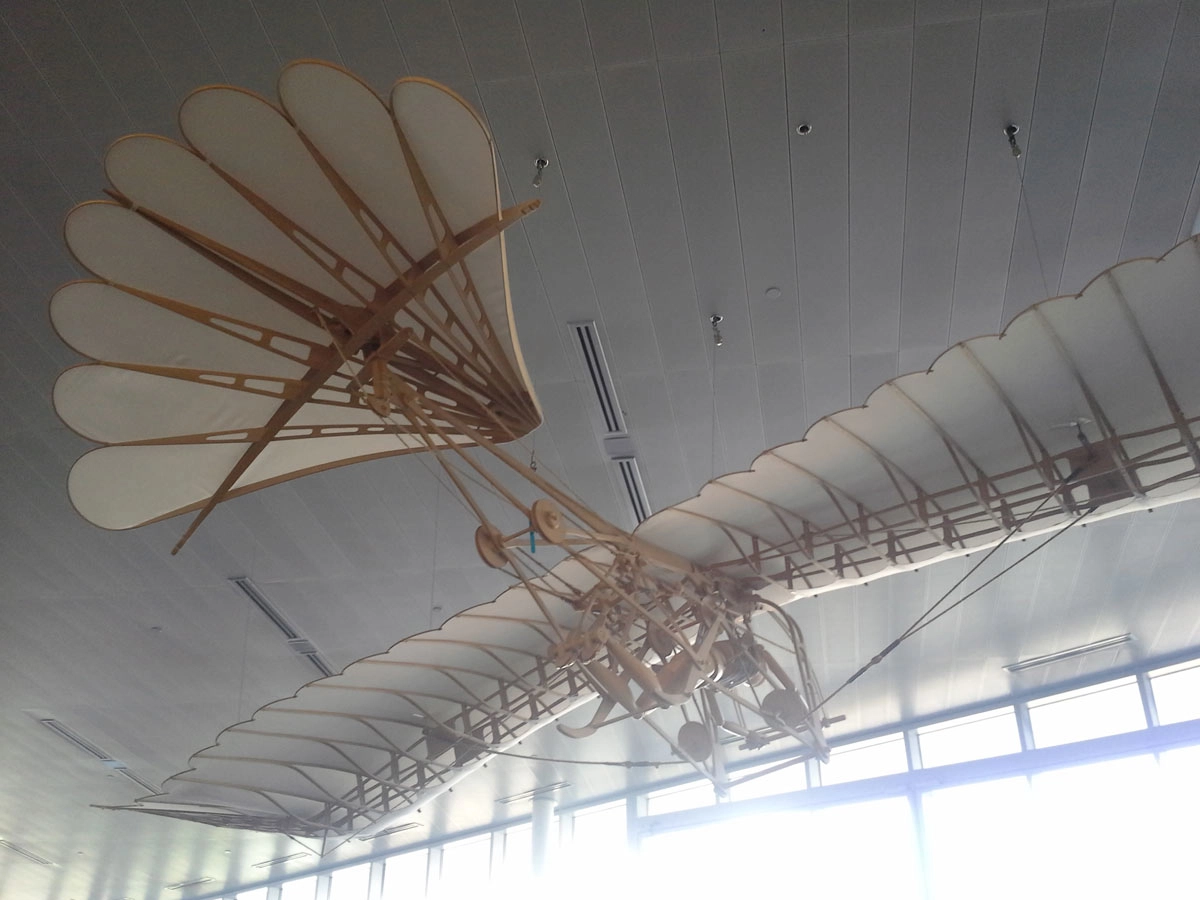
One of his most famous ideas is the ornithopter—a flying machine with flapping wings driven by a human pilot.
On paper, it looks beautiful: a frame with wide wings, meant to be powered by legs and arms. In reality, human muscles simply don’t provide enough sustained power to lift that kind of weight. Without light materials and an external engine, the design was doomed from the start.
But the basic question it tried to answer—how can a person fly by imitating nature?—would echo for centuries.
The Aerial Screw: A Helicopter Before Its Time
Then there’s the “aerial screw”, often called Leonardo’s helicopter.
The design is simple and elegant:
- a circular platform
- a central pole
- a spiral-shaped linen “screw” rising upward
People standing on the platform would rotate the screw, and in theory, the spinning spiral would generate lift and pull the device into the air.
In practice, there were two unsolved issues:
- No engine powerful enough to spin it fast and long enough
- No secondary rotor to stabilize the craft, so the whole machine would just spin
Even so, the principle—using a rotating screw to generate lift—is the same basic idea modern helicopters use. Leonardo didn’t invent a working helicopter, but he perceived a path toward one.
A Parachute That Arrived Four Centuries Late
Leonardo even sketched a parachute: a pyramid-shaped canopy of cloth supported by a wooden frame.
It wasn’t built in his lifetime. But in 2000, a skydiver tested a parachute based on Leonardo’s design, and it worked. Better than that, it reportedly delivered a smoother descent than many modern parachutes.
Was Leonardo the “true” inventor of the parachute? History is rarely that simple. But his design shows he understood not just how to fall—but how to fall safely.
Bridges, Water, and Everyday Genius
It’s easy to get distracted by the flashy stuff—tanks, flying machines, robots in armor. But some of Leonardo’s most practical and successful engineering was much less glamorous.
The Self-Supporting Bridge
He designed a portable bridge using a clever interlocking pattern of wooden poles. No nails, no ropes, no metal—just geometry:
- each beam leans on and locks against the others
- the whole structure supports itself under load
- it can be quickly assembled and taken apart
Military engineers and modern bushcrafters still use versions of this design today. It’s simple, strong, and portable—exactly the kind of thing a field army would love.
Mastering Water: Canals and Locks
Leonardo’s engineering work shone in canal systems. As ducal engineer of Milan in the 1480s, he helped improve the miter lock gates used on the Naviglio Grande canal.
Instead of flat gates, he refined the concept of angled gates that closed against water pressure, sealing more effectively and handling changes in water levels more smoothly. It’s the kind of thing you don’t notice when it’s done well—but ships, trade, and whole economies depend on it.
In other words: yes, he sketched flying machines that never flew, but he also helped make actual infrastructure better in his own lifetime.
The Bobbin-Winder: Small Machine, Big Impact
He also designed an automated bobbin-winder for the textile industry:
- a crankshaft and connecting rod moved the bobbin back and forth
- thread was wound evenly across the surface
- the motion was continuous and regular, unlike hand winding
It solved a real bottleneck: uneven, slow manual winding that limited production. The basic principles behind his winder would later become standard in industrial machinery.
Not all genius has to look dramatic. Sometimes it looks like a better way to wrap thread.
The Mechanical Knight and the Lion That Walked
Then we get to the part that sounds like pure science fiction.
Leonardo sketched and, according to some accounts, built a fully articulated Mechanical Knight around 1495. It was essentially a robot inside a suit of armor:
- internal pulleys and mechanisms moved the limbs
- the neck could bend
- the arms could raise, lower, and even perform grasping motions
It seems to have been designed as a spectacle—a piece of technological theater for his patron. But it shows something powerful about Leonardo’s imagination: he wasn’t just thinking about tools; he was thinking about things that imitated life.
There are also reports of a Mechanical Lion that could walk forward on its own. One version of the story says it opened up to reveal lilies inside as a symbolic gift to the King of France. Whether every detail is true or not, it’s clear that Leonardo was deeply interested in automata—machines that behave like living beings.
Robotics, 500 years early.
Why Leonardo’s “Failures” Still Matter
If you judge Leonardo only by what was built in his lifetime, you might call him a dreamer who rarely finished his machines.
Most of his inventions:
- never left the page
- waited centuries to be tested
- required technologies that didn’t exist yet
But that’s exactly why he still fascinates us.
His notebooks tell the story of a mind that:
- refused to stay in one discipline
- tried to read the rules of nature directly from reality
- constantly pushed existing ideas one or two steps further
Some designs were original. Others were brilliant improvements. All of them came from the same place: a willingness to look closely, think deeply, and sketch boldly.
The artist who painted the world’s most famous smile also imagined tanks, parachutes, flying machines, self-supporting bridges, canal gates, winding machines, and robots in armor—often in a level of detail engineers still admire.
Leonardo di ser Piero da Vinci wasn’t just ahead of his time. In many ways, he was trying to live in a future he could see but couldn’t quite reach with the tools of his age.
And thanks to those notebooks, we can watch him try.