
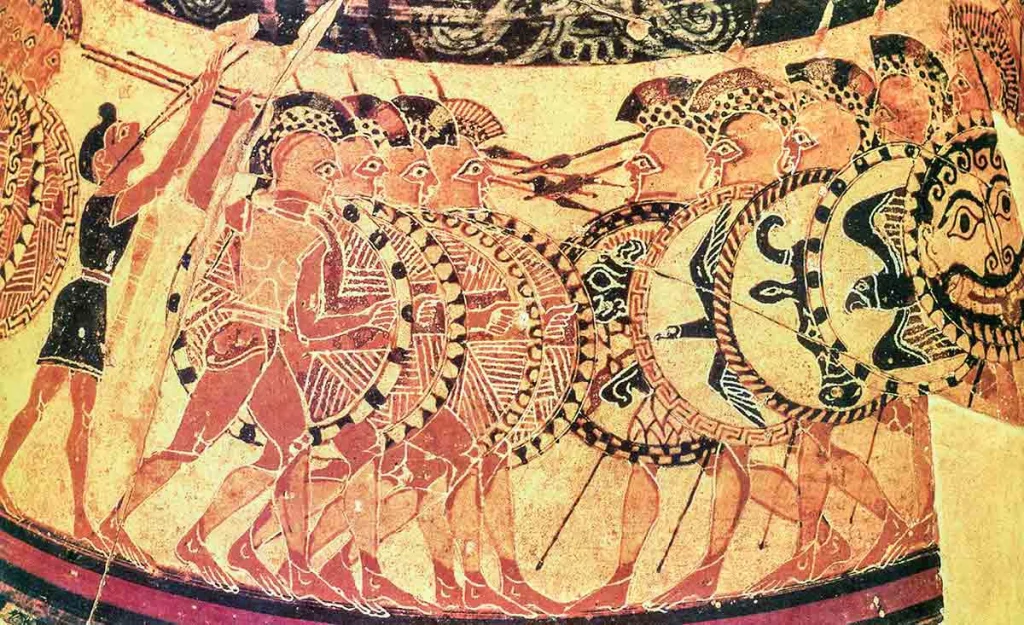
The Hoplite Phalanx: Greece’s Signature Formation
- Core idea: heavy infantry (hoplites) packed shoulder-to-shoulder, shields overlapping, spears projecting.
- Depth & frontage: typically 8 ranks deep; city-states varied (Sparta often deeper for shock).
- Contact & push: advance in step behind a wall of bronze and wood; collisions aimed to break enemy cohesion.
- Discipline > heroics: cohesion, not individual dueling, won battles.
Spartan Refinements
- Training & drill: the agōgē produced superior battlefield discipline and maneuver control.
- Refused flank: Spartans often weighted a wing, protecting the other with oblique positioning and reserve depth.
Theban Oblique Order (Epaminondas)
- Leuctra (371 BCE): Thebes massed elite troops 50 ranks deep on the left and attacked the Spartan right first.
- Effect: a deliberate, staggered engagement—strike decisively with one wing while delaying the rest.
Beyond Bronze Walls: Light Troops and Skirmishers
- Peltasts (javelin bearers): mobile harassment, ideal in rough terrain; they lured phalanxes into disorder.
- Archers & slingers: ranged pressure to pick at exposed flanks and disrupt enemy lines before contact.
- Ambush & raids: Greece’s hills favored hit-and-run, ambushing supply lines and isolated detachments.
Tactical synergy: Skirmishers screened advances, fixed enemies, or provoked premature charges—setting foes up for the main hoplite blow.
Cavalry: Limited but Decisive When Used Well
- Constraints: stony ground and small plains limited shock charges; many poleis fielded modest cavalry.
- Roles: scouting, pursuit of broken troops, striking exposed flanks, and guarding skirmishers.
- Best users: Thessalian horse under Pelopidas; later, Macedonian Companion cavalry made cavalry the battle ender.
Command & Control in the Noise
- Signals: salpinx (trumpets), flag/standard cues, and pre-agreed maneuvers.
- Reserves & rotation: better armies rotated front ranks to keep spear lines fresh; elites served as crisis reserves.
- Morale mechanics: paeans (battle hymns), sacrificial omens, and tight formation ritualized courage and steadied nerves.
Fighting the Terrain and the Calendar
- Ground matters: phalanxes prefer firm, level terrain; ravines, vineyards, and stone walls favored lights.
- Seasonality: campaigning clustered in the dry months; festivals, harvests, and finances shaped strategic timing.
- Fortified poleis: walls and chokepoints (passes, bridges) were as decisive as open fields.
Naval Warfare: How Triremes Won Empires
- Platform: the trireme—200 crew, triple oar banks, bronze ram.
- Ramming tactics:
- Periplous: outflank the enemy line, then strike side or stern.
- Diekplous: thread a gap, wheel, and slam into exposed hulls from the rear.
- Crew quality: precision rowing and quick turns decided fights more than raw hull numbers.
- Marines (epibatai): boarding was a fallback; ramming remained the Athenian specialty.
- Operational art: sea control = grain and tribute. Athens’ naval strategy turned tactics into grand strategy.
Sieges and Poliorcetics (The Art of Taking Walls)
- Early approach: blockade, ravage fields, cut water—starve them out.
- Assault tools: ladders, rams, mining; later, torsion catapults and stone-throwers (4th c. BCE).
- Countermeasures: counter-mines, fire, sallying parties, and layered walls.
- Logistics of pressure: steady pay for besiegers and secure supply lines mattered as much as engines.
The Macedonian Revolution: Purpose-Built Combined Arms
Philip II and Alexander turned Greek ingredients into a fully integrated recipe.
Macedonian Phalanx (with Sarissa)
- Sarissa pike: 4–6 meters, creating a porcupine front; deeper blocks pinned enemies in place.
- Tradeoff: unbeatable from the front on firm ground; vulnerable to flank or rough terrain.
The Team of Arms
- Hypaspists: agile elite infantry guarding phalanx flanks and exploiting gaps.
- Companion Cavalry (shock arm): wedge formations delivered the knockout once the phalanx fixed the foe.
- Light cavalry & missile troops: screened, harried, and chased.
- Artillery on campaign: early field use of catapults to break positions and sow panic.
Result: a choreographed sequence—fix (phalanx), unbalance (missile/light), finish (cavalry).
Strategy: How Cities Turned Tactics into Outcomes
- Attrition vs. decision: some sought one great set-piece (Sparta), others leaned on sea control and resources (Athens).
- Alliances & tribute: hegemony provided manpower and money to sustain sieges and fleets.
- Psychology & politics: defections, revolts, and amnesties often decided wars more cleanly than pitched battles.
Typical Battle Flow (Field Engagement)
- Skirmish line advances—javelins, arrows, stones test the enemy front.
- Phalanx closes under cover of skirmishers; shields lock, spears angle forward.
- Main impact—pushing match, discipline and depth decide.
- Flank actions—light troops and cavalry seek edges or exploit disorder.
- Collapse & pursuit—cavalry runs down routers; disciplined victors restrain pursuit to avoid counter-ambush.
Practical Lessons They Knew (and We Still See)
- Cohesion beats bravado. A disciplined line outlasts heroes.
- Arms must cooperate. Infantry, missiles, and cavalry make each other lethal.
- Master your medium. Athens on water, Sparta on land, Macedon in coordination—each played to strengths.
- Logistics win slowly. Fleets and sieges are supply games in armor.
Quick Glossary
- Hoplite: heavy infantryman with shield (aspis), spear, helmet, cuirass.
- Phalanx: dense line of hoplites fighting as one body.
- Peltast: light infantry with javelins and small shield.
- Periplous/Diekplous: outflanking/penetration naval ramming maneuvers.
- Hypaspists: Macedonian elite foot guarding phalanx flanks.
- Sarissa: the long Macedonian pike.
Key Takeaway
Ancient Greek warfare evolved from citizen phalanxes and seasonal raids to precise naval ramming and, finally, to Macedonian combined arms. The throughline is simple: discipline, coordination, and terrain savvy—qualities that turned city militias into war-winning machines and, with Macedon, forged an empire.

support our project
At History Affairs, we believe history belongs to everyone.
donateYour contribution helps us keep this global archive open, free, and growing — so people everywhere can learn from the past and shape a better future.
know the present
Defense Tech Needs the State, Not Less of It
Trump Era or The New Imperial Age
America First, Venezuela, and the Trap of Old Habits
Why the AI Race Has No Winner
reading more
Pope Leo X Who Helped Ignite the Reformation
Monasticism and the Early Church: Devotion, Expansion, and Daily Life
Nero: Madman or Misunderstood?
Arthur’s Little-Known Brothers
The Tokugawa Shogunate: Isolation and Cultural Renaissance
The Myth of Persistent Anglo-Saxon Paganism?
Women’s Voices in the French Revolution
Knights vs. Samurai: Origins, Codes, and the Real Lives Behind the Armor
The Charge of the Light Brigade: What Really Happened
The West Point Eggnog Riot of 1826
Crassus and the Catastrophe at Carrhae
Erie Canal and the Wedding of the Waters