
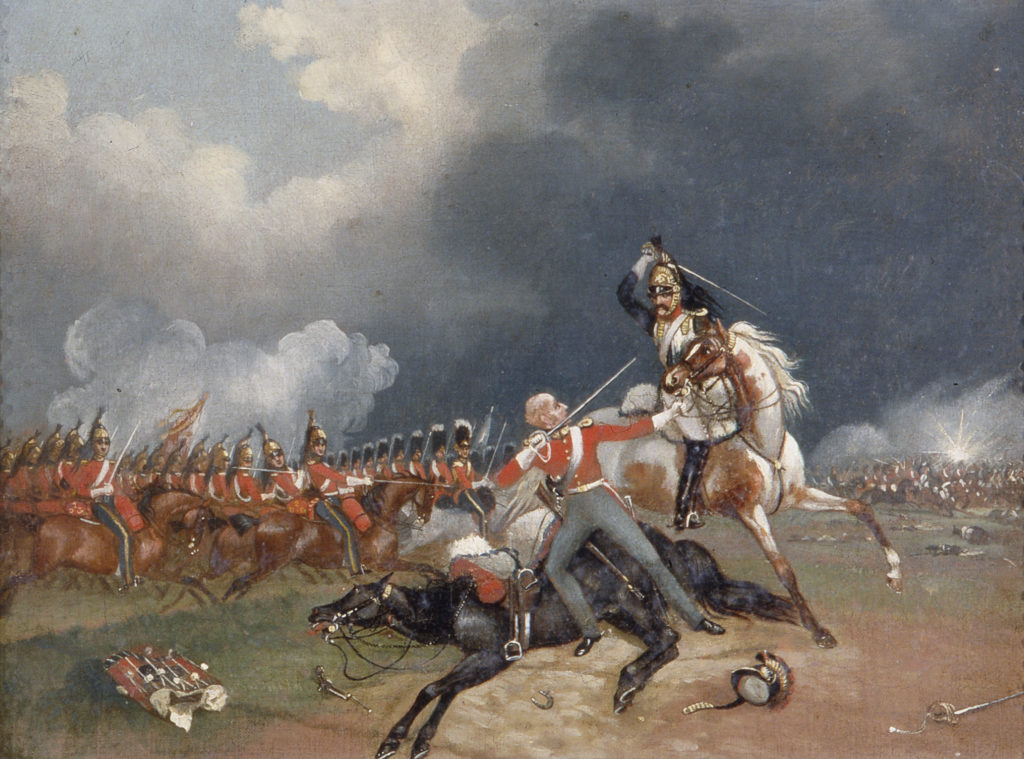
At Austerlitz, he crushed a combined Austrian–Russian army and reached the height of his power in Europe.
At Waterloo, ten years later, he was defeated by the Duke of Wellington and Prussian Field Marshal Blücher, forced to abdicate, and sent into final exile on Saint Helena.
Same commander, very different outcomes. Here’s how the context, armies, leadership, terrain, weather, and results of these two battles compare.
1. Diplomatic Background: Rising Star vs Hunted Outlaw
Austerlitz (1805): Napoleon at His Peak
The Battle of Austerlitz crowned Napoleon’s early rise. Fought on December 2, 1805, the first anniversary of his coronation as Emperor, it was the decisive clash in the War of the Third Coalition.
- Britain’s Prime Minister William Pitt the Younger had pulled together Russia and Austria to stop France.
- European monarchs were alarmed by Napoleon’s behavior:
- The kidnapping and execution of the Duc d’Enghien, a Bourbon prince
- His assumption of the title Emperor of the French in 1804
- The Austrian Emperor Francis II, also Holy Roman Emperor, feared Napoleon would use his influence in western Germany to challenge him for the imperial crown.
Napoleon had originally been massing an army to invade Britain. When that plan was dropped in August 1805, he marched his Grande Armée east. On the way, his forces violated neutral Prussian territory, and the Coalition powers pressured Prussia to join the war.
After Napoleon occupied Vienna, Prussia sent a 30-day ultimatum demanding French evacuation. This sharpened Napoleon’s desire for a quick, decisive victory — one that would end the war before Prussia could intervene. That opportunity came at Austerlitz.
Waterloo (1815): The Return of the Outlaw
The situation in 1815 could not have been more different.
Napoleon had already suffered disaster in Russia (1812), followed by heavy defeats in Germany (1813). In 1814, Allied troops captured Paris, and he abdicated, going into exile on Elba.
But on February 26, 1815, he escaped. Within weeks, he was back in Paris and once again Emperor, in what became known as the Hundred Days.
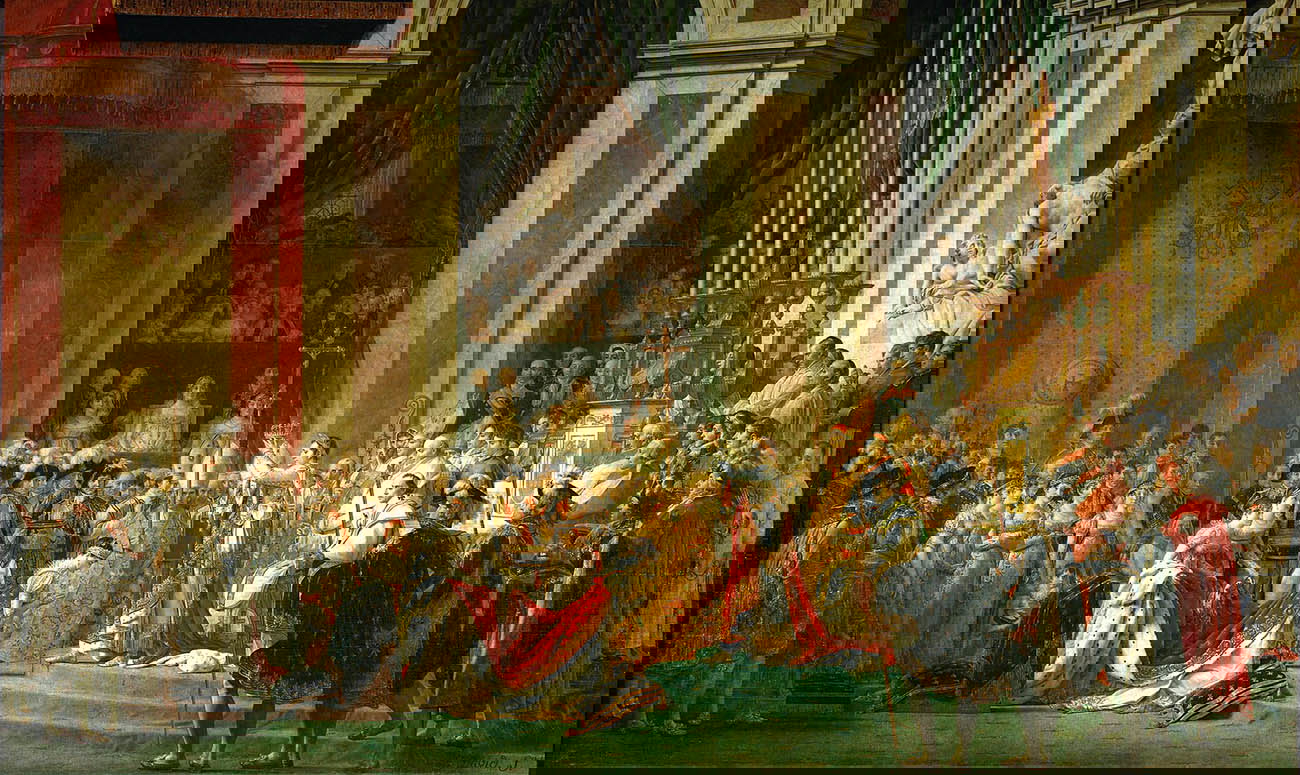
The victorious powers were gathered at the Congress of Vienna, arguing over how to reshape Europe. Napoleon’s return instantly united them again in the Seventh Coalition.
This time:
- Napoleon insisted he wanted peace.
- The Allies declared him an outlaw and promised to overthrow him again.
- Around 600,000 Allied troops were expected to move against France.
Knowing he couldn’t wait to be crushed from all sides, Napoleon launched a pre-emptive strike in June 1815 against Wellington’s Anglo-Allied army and Blücher’s Prussians in what is now Belgium. His goal: defeat them quickly and improve his bargaining position before Austrian and Russian armies arrived.
2. The Armies: The Grande Armée vs the Worn-Out War Machine
Austerlitz: The Grande Armée at Its Finest
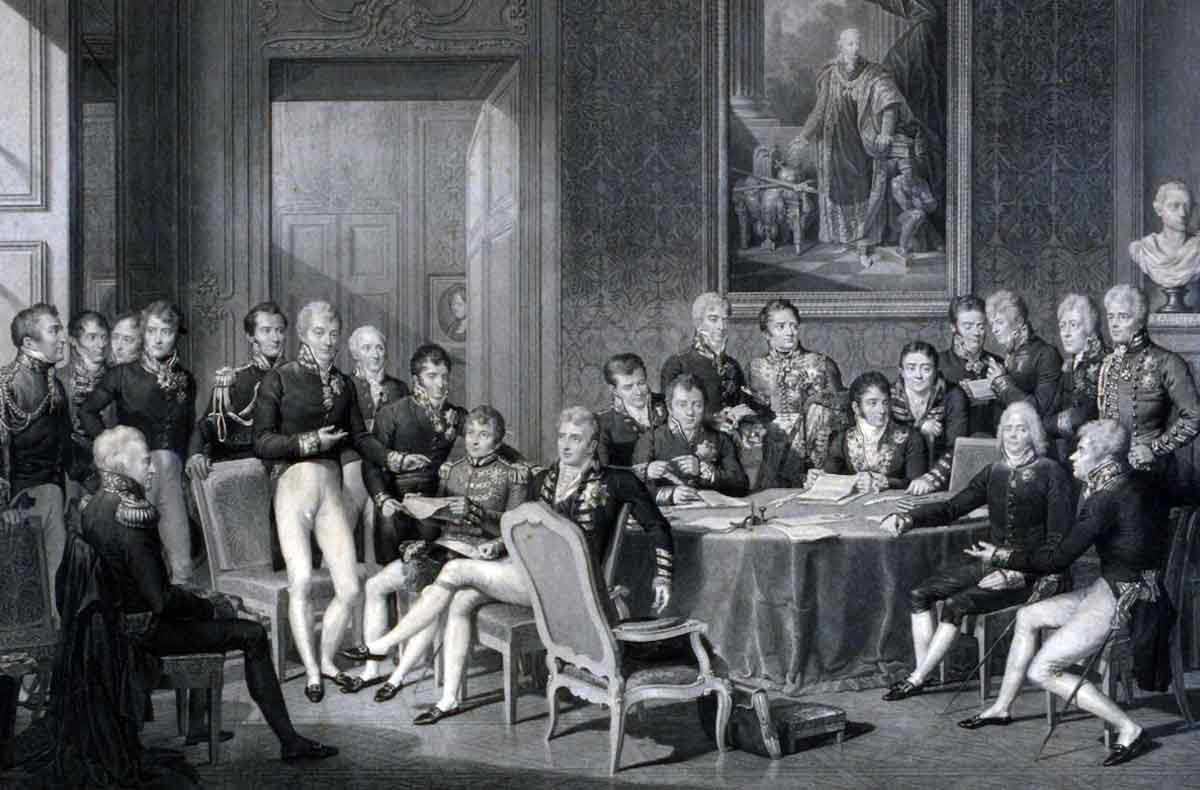
The force Napoleon led in 1805 was his legendary Grande Armée, originally assembled as the Army of England for a cross-Channel invasion.
From 1803 to 1805, his soldiers trained in large camps around Boulogne. This long preparation:
- Sharpened their skills
- Built a powerful esprit de corps — the men believed not just in Napoleon, but in each other.
Napoleon’s key strength was his corps system, organized with his chief of staff, Marshal Berthier:
- Each corps had about 20,000–30,000 men
- Each could march and fight independently
- Together, they could rapidly concentrate on a battlefield
This flexible structure let the French move faster than Austrian and Russian armies, which still marched in huge, slow blocks that clogged the roads.
The result:
- Napoleon trapped General Mack at Ulm, forcing a major Austrian surrender before Austerlitz.
- At Austerlitz itself, French units were highly trained, well-organized, and responsive to orders.
The Allied troops were brave and capable, but hampered by slow communication, clumsy command structures, and mistrust between Austrian and Russian officers.
Waterloo: A Mixed, Tired, and Incomplete Force
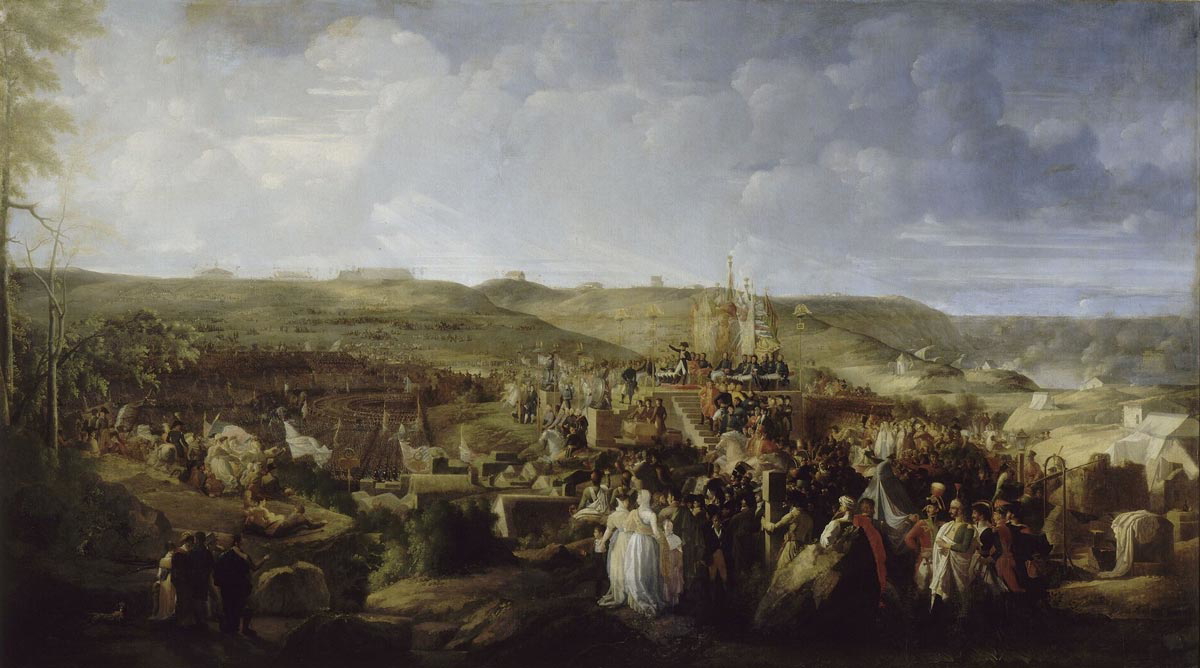
By 1815, the Armée du Nord Napoleon led at Waterloo was a pale echo of the old Grande Armée.
- There were still some loyal veterans, but many troops were raw recruits with little battle experience.
- Napoleon’s best soldiers had been killed or scattered in the disasters of the previous years.
Wellington’s army was also far from perfect:
- His Anglo-Allied force included many Dutch and Belgian troops with limited combat experience.
- Some of his finest veterans from the Peninsular War had been shipped to North America and had recently suffered defeat at New Orleans.
The Prussian army, however, contained a large number of hardened veterans from the 1813–1814 campaigns.
And importantly, by 1815 both Allied armies were also organized into corps, erasing the organizational advantage that Napoleon had enjoyed in 1805. This allowed the Prussians, for example, to regroup after defeat at Ligny and still arrive at Waterloo in time to save the day.
3. Leadership: Genius and Its Limits
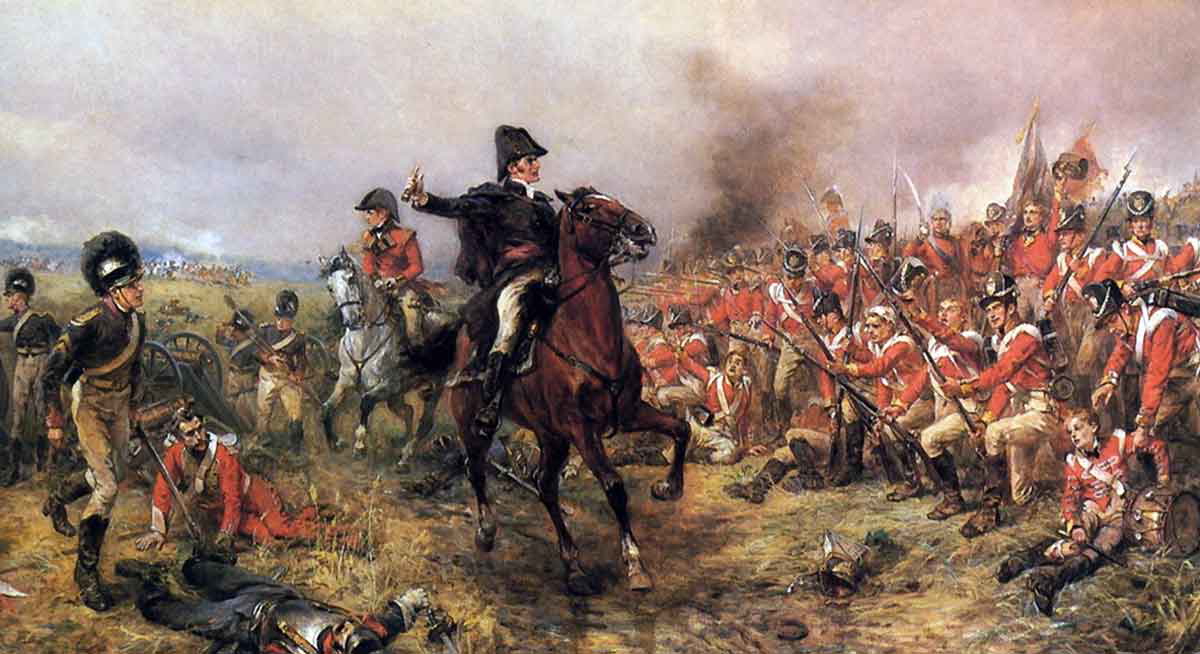
Austerlitz: Napoleon at His Brilliant Best
At Austerlitz, the 36-year-old Napoleon was at the height of his powers.
He had:
- Just executed a brilliant operational victory at Ulm
- A clear sense of enemy weaknesses
- Some of his finest marshals on hand, including Davout, Lannes, and Soult
On the Allied side, things were far shakier.
- After Ulm, the main Allied force was commanded by Mikhail Kutuzov, who conducted a skillful retreat while waiting for reinforcements.
- But at the crucial moment, Kutuzov’s objections to the battle plan crafted by Austrian chief of staff Franz Weyrother were ignored.
- Tsar Alexander I and his circle sidelined Kutuzov, and command became muddled.
Weyrother’s plan focused on a major attack against the French right, using roughly half the Allied army. On paper, it was an attractive idea — roll up Napoleon’s flank and crush him.
In reality, it:
- Underestimated Davout’s defensive skill
- Ignored the danger of a French counterattack through the weakened Allied center
- Was carried out by the unreliable Russian general Buxhöwden, reportedly drunk on the day of battle
Napoleon read his enemies beautifully and struck at the perfect moment.
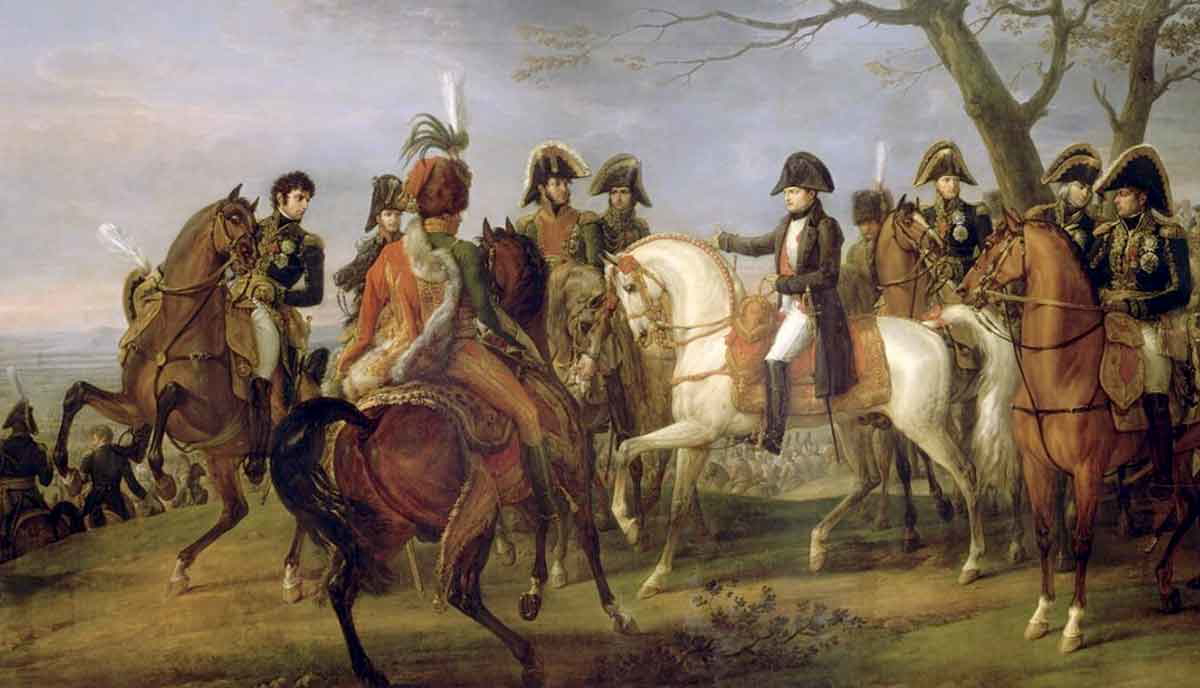
Waterloo: A Weaker Napoleon vs Wellington and Blücher
By Waterloo, Napoleon was nearly 45 and in poorer health. He had shown flashes of his old brilliance during the 1814 French campaign, but he was no longer at his best.
He was also missing several key figures:
- Lannes was dead (killed in 1809).
- Masséna was disgraced.
- Berthier, his long-time chief of staff, refused to join him and died in mysterious circumstances on June 1, 1815.
- Davout was left in Paris as Minister of War.
Napoleon’s new team was weaker:
- Soult served as chief of staff but could not match Berthier’s efficiency.
- Marshal Ney, brave to the point of recklessness, lacked the calm control needed for handling large, complex operations.
- Marshal Grouchy, given the vital task of pursuing the Prussians or rejoining Napoleon at Waterloo, was an able cavalry commander but inexperienced at high-level independent command.
On the Allied side:
- Wellington, the same age as Napoleon, was in better physical condition and had fewer political headaches. He had beaten some of Napoleon’s best marshals in Spain and Portugal, though he had never faced Napoleon himself.
- Blücher, at 72, was old and sometimes mentally unstable, but he was aggressive, determined, and burning for revenge after Prussia’s humiliation in earlier wars. His resolve to support Wellington at all costs was crucial.
At Austerlitz, Napoleon faced divided, overconfident opponents. At Waterloo, he faced two determined, experienced commanders working — despite difficulties — toward the same goal.
More Stories
4. Terrain, Tactics, and Weather
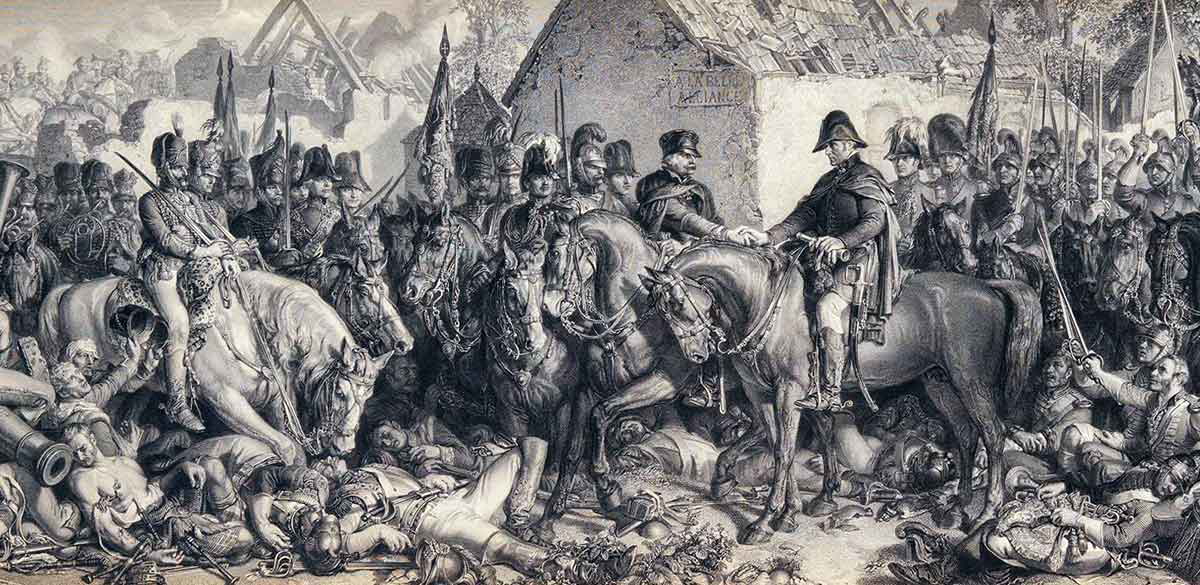
Austerlitz: The Trap on the Pratzen Heights
The key feature at Austerlitz was the Pratzen Heights, a gently rising plateau that dominated the battlefield.
Napoleon did something bold and counterintuitive:
- He gave up the heights and took position behind the Goldbach stream, making his right flank deliberately weak.
- He correctly guessed that the Allies would see his right as vulnerable and mass troops there for a knockout blow.
When the Allies shifted their strength to attack his right, they thinned their center. At the decisive moment, Napoleon ordered Soult’s IV Corps (about 16,000 men) to surge forward and seize the Pratzen Heights.
This:
- Split the Allied army in two
- Collapsed their center
- Turned their ambitious plan into a disaster
Weather helped him too. A cold, misty December morning hid much of his army’s movements. When the sun finally broke through and revealed French troops advancing up the heights, it was too late for the Allies to recover — giving rise to the legend of the “Sun of Austerlitz.”
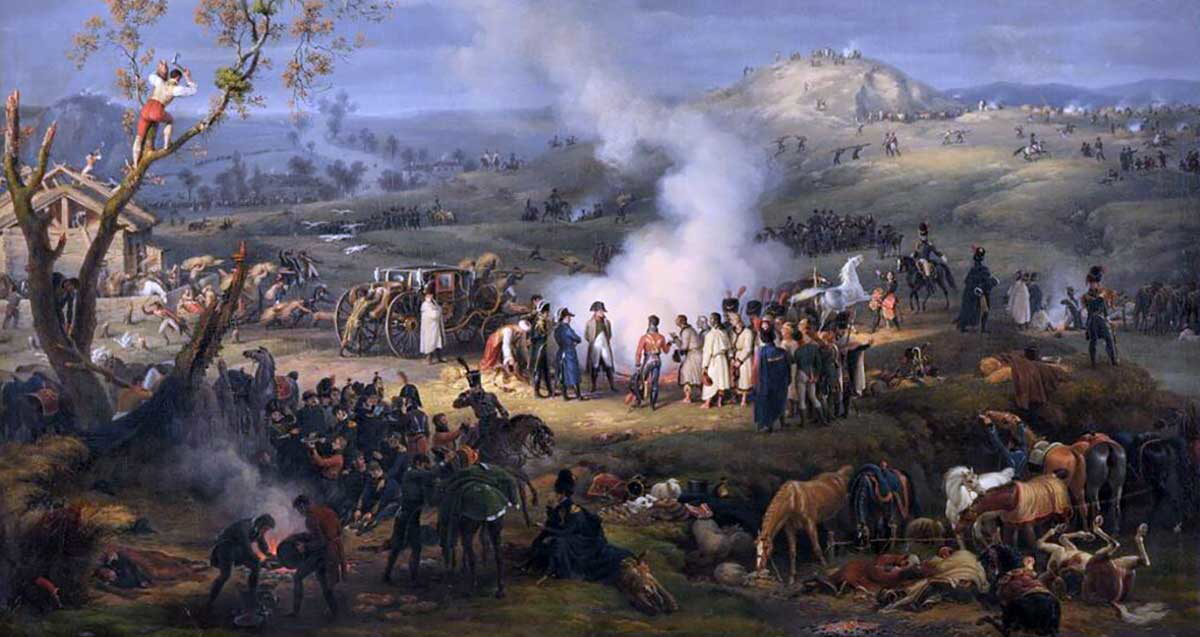
Waterloo: A Defensive Ridge and a Missed Flank
At Waterloo, Wellington chose a low ridge south of the town to block the road to Brussels. His army sheltered on the reverse slope, hidden from much of the French artillery.
In front of the ridge were key strongpoints:
- Hougoumont
- La Haye Sainte
- Papelotte
These farms and hamlets became brutal focal points of the fighting, slowing and blunting French attacks.
Unlike Austerlitz, Napoleon had to attack:
- Wellington was not going to advance.
- Napoleon needed to defeat him quickly before the Prussians arrived.
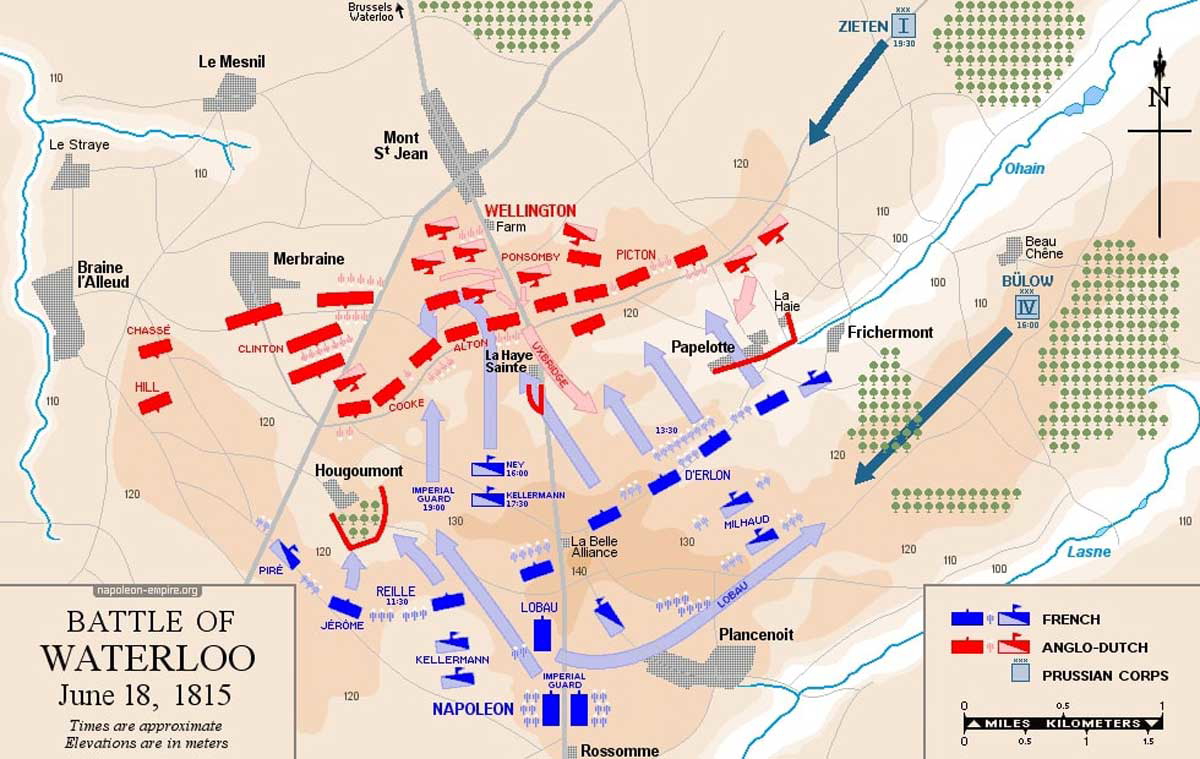
The day before the battle, heavy rain turned the ground into mud. On June 18, Napoleon delayed the main attack until late morning, often explained as waiting for the soil to dry so his guns could be effective. Either way, the result was the same: the Prussians had more time to march to the field.
Napoleon’s tactics at Waterloo were far less imaginative than at Austerlitz:
- A heavy artillery bombardment that could not fully reach Wellington’s troops behind the ridge
- Repeated frontal assaults rather than serious attempts to outflank the Allied line
- Growing pressure on his own right flank when Bülow’s Prussian IV Corps attacked at Plancenoit
At Austerlitz, Napoleon used the terrain to lure and trap his enemies. At Waterloo, the terrain and the weather worked against him, and his own plan did little to shift the odds.
5. Outcome: Triumph vs Final Defeat
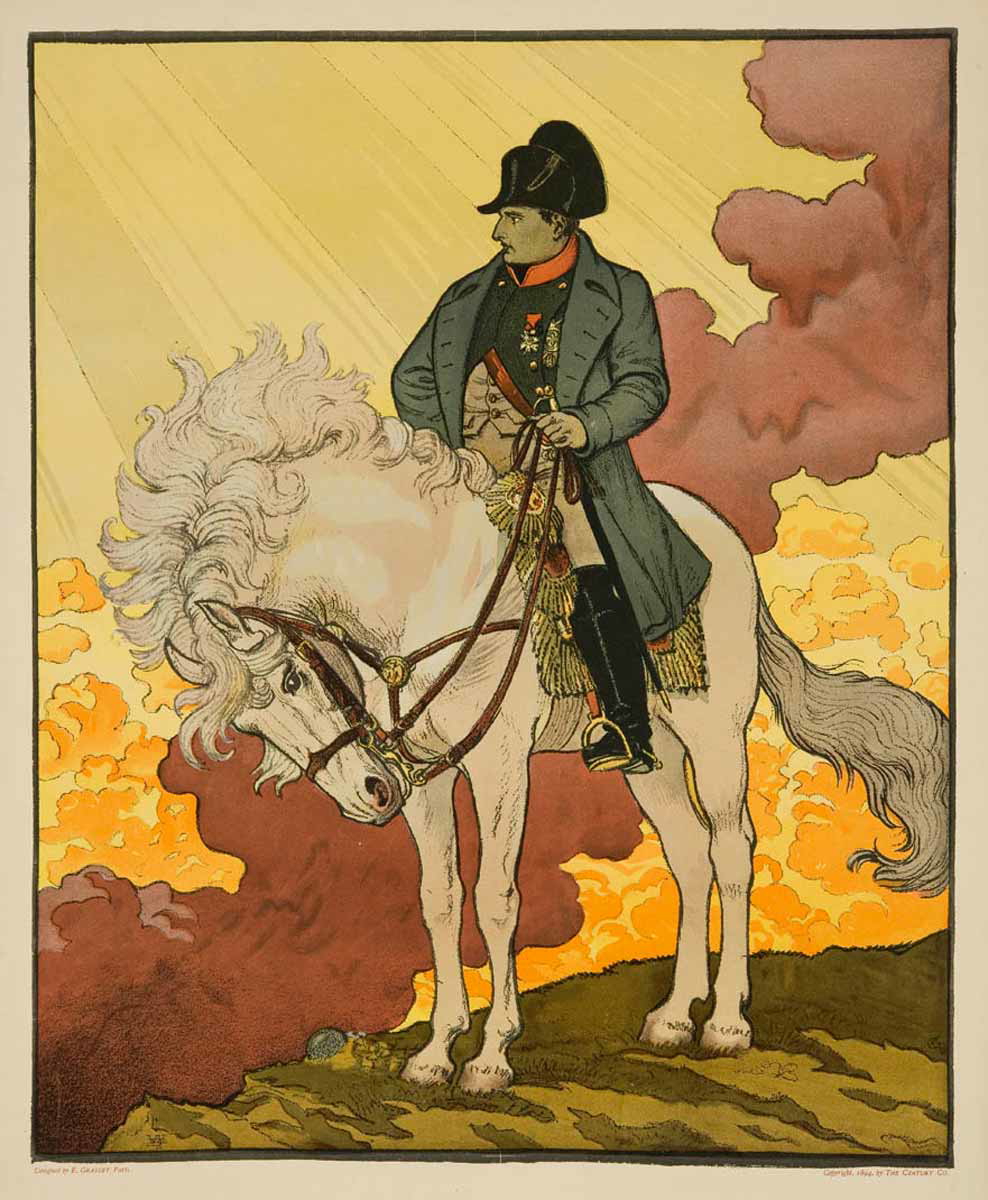
After Austerlitz: Napoleon Master of Central Europe
Austerlitz was more than just a battlefield win. It reshaped the map of Europe.
After defeating the Third Coalition:
- Napoleon created the Confederation of the Rhine in 1806, bringing much of western Germany under his sway.
- Emperor Francis dissolved the Holy Roman Empire, ending an institution that had existed for nearly a thousand years.
- In October 1806, Napoleon crushed Prussia at Jena and Auerstedt.
- In 1807, he defeated Russia at Friedland.
By the Treaty of Tilsit, Napoleon effectively dominated western and central Europe. Austerlitz was the victory that made this possible — it marked the high point of his power.
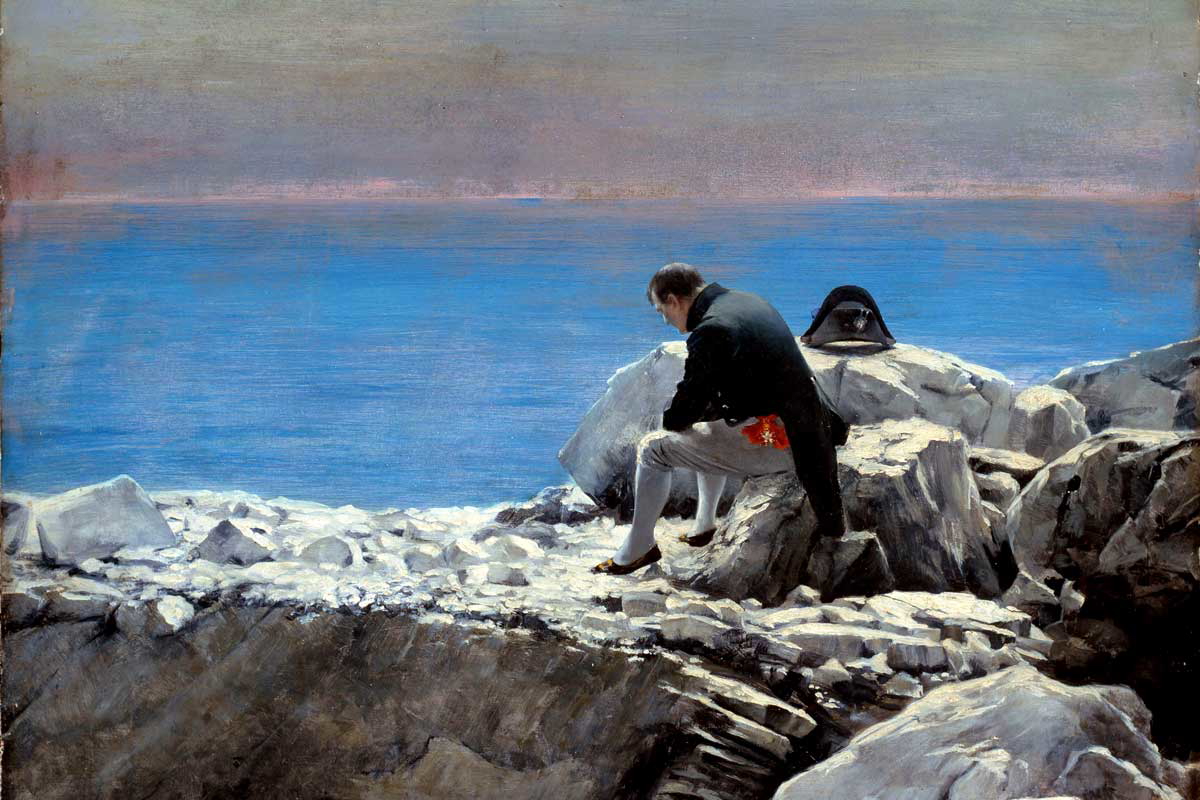
After Waterloo: The End of the Napoleonic Era
Waterloo had the opposite effect.
- Napoleon abdicated again on June 22, 1815.
- He hoped to escape to North America, but the Royal Navy’s blockade and the threat of capture by the Prussians forced him to surrender to the British.
- Instead of a manageable exile like Elba, he was sent to Saint Helena, a remote island in the South Atlantic, where he died in 1821.
In France, Louis XVIII returned to the throne.
In Europe, the Congress of Vienna finalized its settlement. Despite heated arguments, the great powers managed to create a balance that prevented major war between them until the Crimean War (1853–1856).
In short:
- Austerlitz made Napoleon the master of Europe.
- Waterloo ended his rule and closed the chapter on the Napoleonic age.
Two battles, ten years apart — one under a rising sun, the other under leaden skies — together mark the dramatic arc of Napoleon’s rise and fall.

support our project
At History Affairs, we believe history belongs to everyone.
donateYour contribution helps us keep this global archive open, free, and growing — so people everywhere can learn from the past and shape a better future.
know the present
Defense Tech Needs the State, Not Less of It
Trump Era or The New Imperial Age
America First, Venezuela, and the Trap of Old Habits
Why the AI Race Has No Winner
reading more
“O Jerusalem!”: Saint Louis, the Cross, and the Making of a Christian King
Story of the First Legend Hero: Cadmus
The Election of 1800: How a Bitter Battle Redefined American Democracy
John Marshall: The Justice Who Defined the Supreme Court
From Jōmon to Yayoi: Japan Shifted from Foragers to Rice Farmers
Strabo: The Man Who Wrote the World for Empire
The Enduring Unity and Adaptability of Christian Morality
New Year, Old Books: A Tradition of Book Giving
Svalbard: From “Cold Coast” to Doomsday Vault
Judicial Errors in the Trial of Jesus
Erie Canal and the Wedding of the Waters
Egyptian Art: From Balance to Brilliance