
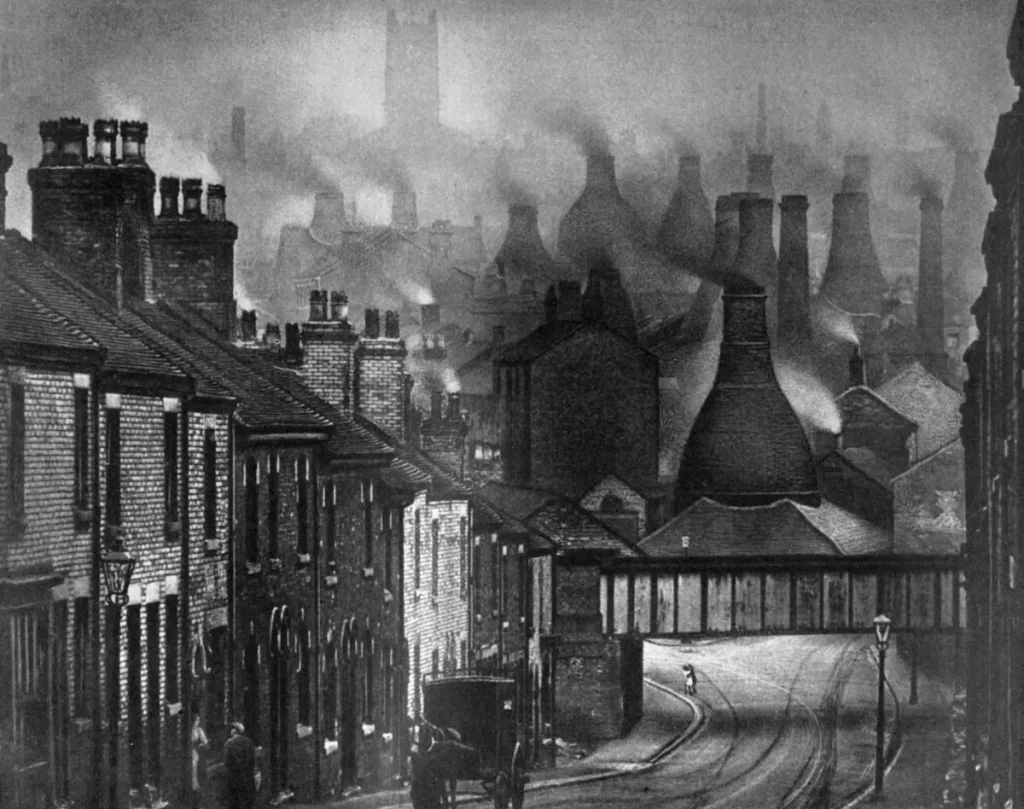
On a summer day in 1940, as the Luftwaffe sharpened its claws and Britain braced for the Battle of Britain, a quiet letter slipped into town halls across the country. It did not carry stirring slogans or morale-boosting poetry. It carried instructions. The Ministry of Home Security wanted smoke—more of it, thicker, darker, and on demand.
In an age that already coughed beneath coal’s black breath, the government’s new directive was extraordinary: a deliberate programme to blanket the nation’s vital industrial sites in smoke, masking them from enemy aircraft. For the National Smoke Abatement Society (NSAS)—a group that had spent a decade winning arguments and inching Britain toward clearer skies—it felt like history shifting into reverse.
This is the story of how a nation fighting for its life also fought with its lungs; how engineers, inspectors, and campaigners wrestled over what belonged in the air; and how the “smog of war” set the stage for a cleaner peace.
Before the Blitz: Building a Clean-Air Cause

The road to that 1940 letter began far from Whitehall, in the spa town of Buxton. There, in 1929, two long-lived pressure groups—the Coal Smoke Abatement Society (1899) and the Smoke Abatement League of Great Britain (1842)—merged to become the National Smoke Abatement Society. The new organisation, pragmatic and cash-strapped, set out a bold mission in its first annual report (1930): end industrial and domestic smoke, popularise smokeless heat and power, and push for laws that would cleanse the air.
The scale of the challenge was staggering. A Ministry of Health committee in 1921 estimated Britain expelled around three million tons of soot each year—waste particles, fumes, grit, and dust. Five years later, a Royal Commission translated that waste into human effort: roughly three days of output from all the nation’s collieries, the work of over a million men, lost to the sky as pollution. The figures shocked the public. Parliament, jolted into action, passed the Public Health (Smoke Abatement) Act in 1926, defining “smoke” to include soot, ash, and grit, and enabling penalties for smoke nuisances. New instruments went up on rooftops to measure sulphur dioxide and lead peroxide. By spring 1940, data told a hopeful story: Britain’s air, though far from clean, was improving.
The NSAS, buoyed by incremental wins and growing public sympathy, believed it could argue for efficiency in the name of economy and health. Burn coal better, they said, and you burn less; emit less smoke, conserve fuel, save money, and spare lungs. It was a tidy equation—until war scrambled the math.
“Let There Be Smoke”: A Wartime Pivot

War changes priorities. In the autumn of 1939, the NSAS admitted in its journal, Smokeless Air, that some peacetime campaigns would stall. Still, during the “Phoney War,” it found ways to keep working: members lectured nationwide under the Ministry of Information’s umbrella, pamphlets argued that smoke betrayed positions to enemy eyes, and efficiency was pitched as patriotism. The society’s January 1940 pamphlet put it bluntly: smoke signals waste. Stop the smoke, save the fuel, protect industry.
But by June 1940, the logic in London shifted from visibility to invisibility. On 20 June, selected local authorities received a confidential circular from the Ministry of Home Security’s little-known Smoke Production Division at Horseferry House. The instruction was terse and urgent: organise “all industrial works” to emit as much extra smoke as feasible, “without incurring too much waste,” to make targets “less readily definable” from the air. Inspectors were to call on every factory with a furnace; combustion engineers would advise on how to blacken the sky most effectively. Legal protections, the circular hinted, would shield compliant firms from prosecution.
Twelve days later, a second, SECRET circular made the plan more ambitious still: coordinated “smoke protection schemes” would roll out during periods of moonlight—beginning 14 July—when bombers could navigate more easily. On 13 August, after the Battle of Britain had begun in earnest, a further circular widened the remit to include non-industrial premises (though not homes) across a sweep of regions: Bristol, South Wales, London, the Black Country, the Potteries, Lancashire and Merseyside, Yorkshire, Teesside, Tyneside, and all of Scotland. Authorities were told to list laggards: premises “not making much of an effort” at extra smoke.
Smoke, once a nuisance, was now camouflage. Britain would fight with fog.
The NSAS Pushes Back—Quietly

The NSAS learned of the policy through contacts in local government and reacted as you might expect from an organisation named for smoke abatement. The plan, they argued, was backward on two counts.
First, it spoiled fuel when every lump of coal mattered. Smoke is evidence of incomplete combustion; a clean burn yields heat and fewer particulates. Wasting energy in wartime was folly.
Second, and more provocatively, it was tactically suspect. Broad smoke pall might confuse the Luftwaffe—but it could also signal where industry clustered, tracing factory lines across countryside otherwise quiet. Worse, smoke made life harder for British pilots and ground defence. After the war, a meteorological officer, Flying Officer Arnold Chadwick, would echo the point: “smoke haze” during the war created serious visibility problems, even for takeoffs and landings.
The society wrote to ministries in 1940 and again in 1942, urging withdrawal. But wartime activism walked a narrow ridge. Public petitions felt like dissent; newspaper columns risked revealing sensitive information. The NSAS adapted: headquarters moved out of central London in response to bombing, staff left for national service, paper rationing shrank its journals, and committee meetings vanished under transport strain. Lobbying went private—letters, phone calls, quiet conversations in offices and clubs. By 1943, the Ministry of Town and Country Planning would grumble internally that “the National Smoke Abatement Society is again on the war path.” The war path, in practice, was the postbox.
Even its adverts were weapons: Smokeless Air ran promotions for Coalite—the smokeless fuel invented in 1904—under the headline “Clean the Skies for the RAF,” turning chemistry into a moral argument. Why burn potential petrol, diesel oil, tar acids, and other extractable products straight into the air when those materials could serve the war? The NSAS had even awarded Coalite’s inventor a posthumous medal in 1936. War sharpened the point: polluting the sky with the “poisonous products” of combustion was, the advert claimed, a “double crime.”
Thick Air, Thin Patience

Did the smoke screens work? The truth, then as now, is mixed. With factories on round-the-clock shifts, coal of inconsistent quality, and new wartime plants blooming like steel flowers, emissions rose. Enforcement of peacetime abatement laws was difficult, then formally suspended in 1943. Monitoring equipment dwindled, but not to zero; enough sites kept recording to reveal a wartime spike in pollution, peaking in 1941–42 when smoke production was pursued most aggressively. The skies, already burdened by industry, grew heavier still.
The government held course until February 1943, when fuel efficiency finally claimed pride of place and the Luftwaffe’s threat had waned. The smoke production policy was discontinued, albeit with bureaucratic face-saving: a circular insisted smoke still “contributes materially to the air defence of vital points in industrial areas.” Perhaps it sometimes had. But the balance of priorities had shifted.
For the NSAS, this was a partial vindication, but hardly a victory lap. The war had diverted attention, personnel, and paper from their cause. And yet, paradoxically, it had also clarified their message. The nation had seen how profoundly air, coal, and industry intertwined. The society’s funds rose during the war years—modestly in absolute terms, but enough to fuel plans for the peace. If reconstruction meant new houses and factories, why not bake in clean combustion from the blueprint stage?
After the Guns: Winning (and Losing) the Peace

By 1946, the NSAS believed it was in the strongest position of its life, with more local authorities joining as institutional members and the public more conscious than ever of smoke’s cost. It rebranded in 1958 as the National Society for Clean Air, emphasising breadth beyond mere smoke. (Much later it would become Environmental Protection UK, and, in 2024, fold its legacy into the Institution of Environmental Sciences through the Environmental Policy Implementation Community.)
But the immediate postwar years were choppy. The nation was rebuilding on a tight budget. Manufacturers clung to old machinery; ministries learned to say no. Other voices crowded the room—housing, jobs, transport, rationing—each urgent, each deserving. The NSAS had “a good war,” but influence is a tide, and theirs did not flood the shoreline overnight.
Then came December 1952. London sank under a vast, lethal fog: smoke plus temperature inversion plus still air. Up to 12,000 died. The horror galvanized Parliament and public alike. The Clean Air Act of 1956 followed, nudging industry and households toward smokeless fuels and cleaner appliances, empowering councils to declare smoke control areas, and tightening the legal net around soot.
It took a catastrophe to legislate common sense, but legislate it Britain did.
What the Smoke Taught
It is easy, from our vantage point, to flatten this history into caricature: villains in stovepipe hats belching coal; heroes in white coats waving data. The truth is messier and more human. The wartime smoke policy was born in fear and pragmatism, a gambit in a game with existential stakes. The NSAS, stubborn and right about the long run, had to swallow secrecy, ration paper, and negotiate with officials who shared their patriotism but not their priorities. Local inspectors tried to enforce laws without staff. Factory owners burned what coal arrived. Pilots flew through haze.
And yet, between the letters and the charts, something enduring took shape: a new way of talking about air, rights, and responsibility. The NSAS made the case that cleanliness was not a luxury but a civic duty; that “dirt” was “matter in the wrong place”; that waste warmed the sky and starved the war machine; that equipment could be better; that law could help. Even the state’s smoke screens, perverse as they seem, acknowledged air as a medium of strategy—something that mattered enough to be engineered.
When the war ended, the NSAS asked a simple question with radical consequences: If we can organise to fill the sky with smoke, why can’t we organise to clear it?
Epilogue: Horseferry House and a Long Arc
There is a fitting footnote to this saga. Horseferry House in Pimlico—wartime home of the Smoke Production Division—later, for a period, housed the Environment Agency. Bureaucratic addresses change, but the arc is suggestive: from learning to make smoke to learning how not to.
The long arc of Britain’s clean-air story bends through Buxton’s committee rooms, past the circulars that summoned moonlit smokes, across the clipped minutes of cautious meetings, through factory gates and lab benches, to the green ink of the Clean Air Act. It bends through adverts that made chemistry patriotic, through numbers extracted from stained filters, through pilots’ squinting descents into yellow haze. It bends, finally, to a present where air is measured, modelled, and—though still contested—more carefully guarded.
The smog of war has lifted. The lesson remains: what we put into the air shapes more than the skyline; it shapes the kind of country we are.
Key Takeaway
Britain’s wartime smoke screens turned pollution into camouflage, colliding with a decade of progress by the National Smoke Abatement Society. The clash sharpened the nation’s understanding of air as both a strategic asset and a shared resource—setting the table for postwar reforms and, ultimately, the Clean Air Act of 1956.

support our project
At History Affairs, we believe history belongs to everyone.
donateYour contribution helps us keep this global archive open, free, and growing — so people everywhere can learn from the past and shape a better future.
know the present
Defense Tech Needs the State, Not Less of It
Trump Era or The New Imperial Age
America First, Venezuela, and the Trap of Old Habits
Why the AI Race Has No Winner
reading more
Aelfgifu: Queen of England and Denmark
The Rose: A Short History
Suez Canal: From Ancient Dream to Present Reality
The Crisis of the Third Century of Roman Empire
5 Arctic Explorers Who Revealed the Unknown World
Origin of Merlin: Prophet and Wizard
Adam Smith: The Philosopher Who Revolutionized Economics
Locke and the Morality in Early Modern England
Martin Heidegger: Genius in the Shadow
The Tokugawa Shogunate: Isolation and Cultural Renaissance
The Fifth Labor of Heracles: Cleaning the Augean Stables
The Secret of the Black Chamber: How Letters Were Spied On in 18th-Century Europe