
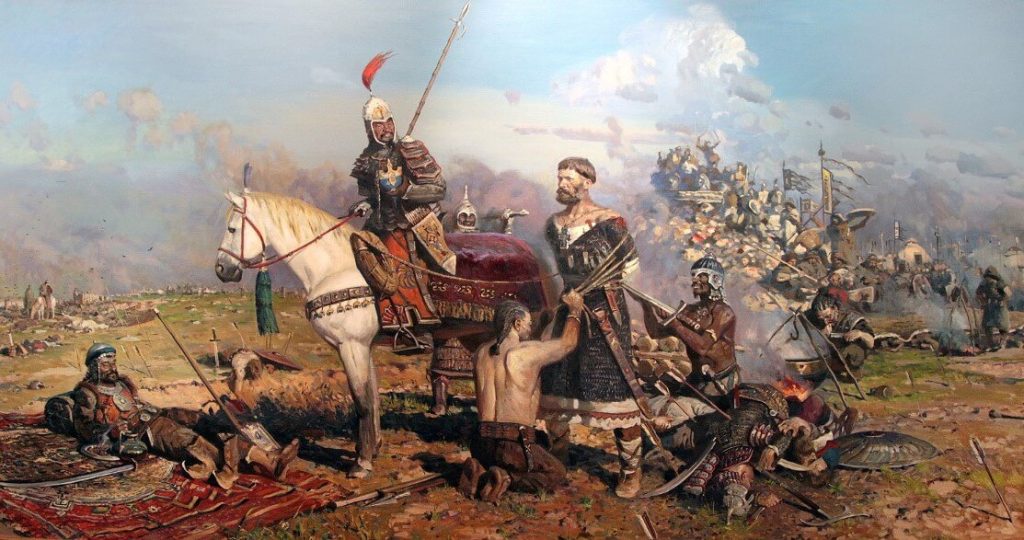
Early in 1221, as the Fifth Crusade huddled inside Damietta and plotted a push toward Cairo, a rumor slipped through the camp like a blessing. Messengers swore that a Christian king named David was thundering out of Asia with a great army, ready to shatter Islam’s strongholds and open the road to Jerusalem. Letters flew from Egypt to courts and cloisters across Europe. Encouraged—perhaps intoxicated—by this promise, the crusaders broke from Damietta to strike at the Nile.
King David never came. Within weeks the crusader host was undone, Damietta lost, the road to Cairo closed. Later, a chronicler would sigh that David had simply “returned to his realm” when he heard the bad news. In truth, he’d never existed. The figure was a fantasy stitched from scraps—half Prester John, half distant warlord—and the brightest threads came from reports of a horse-lord named Chinggis Khan.
What makes this rumor more than a footnote to a failed campaign is its timing: it is the first moment Europe “hears” the Mongols. Christian communities living under Islam had listened to the far-off drumbeat of Mongol victories and, desperate for deliverance, conjured a savior from it. Their whispered hope traveled along caravan routes and church networks until it reached Damietta. From there, the story crossed the Mediterranean—Europe’s first living rumor of an empire that was about to yank both ends of Eurasia into the same conversation.
“Where have they lain concealed?”
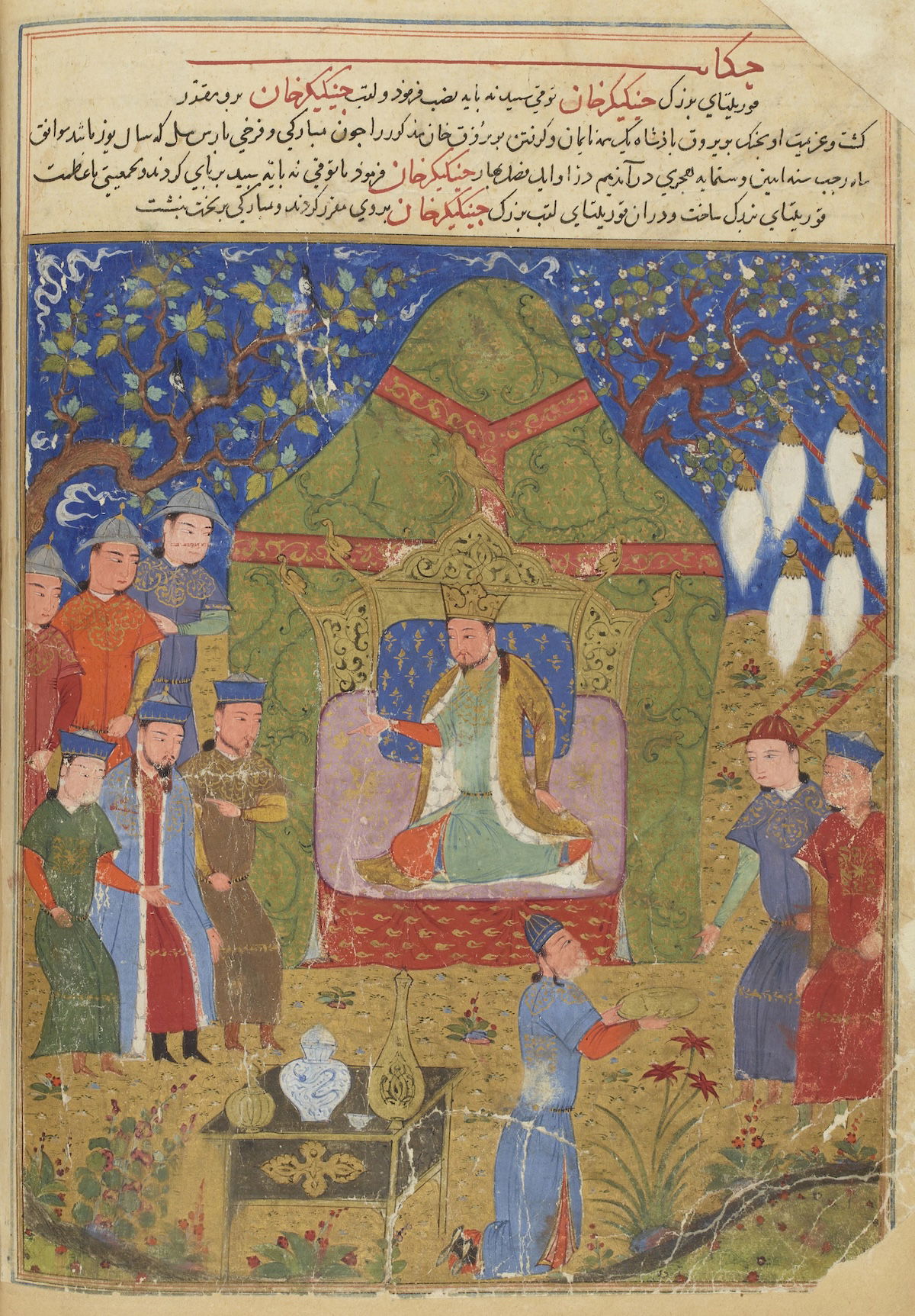
France stands near the center of what followed. It was a kingdom that thought in long horizons: crusades, diplomacy, royal chronicles, encyclopedias. Among the French leaders at Damietta was Jacques (James) of Vitry, who dutifully forwarded the King David letters to Paris. He could not know he was founding, almost by accident, one of the richest European archives on the Mongols.
The next ripples became shockwaves. In 1237, news reached French monasteries that the “Tartars” were rolling west under Ögedei Khan—killing the mysterious Prester John (so the tale went), ravaging Armenia, and pushing toward the Hungarian plain. For a few years the tidings were scattered, half-heard. Then, in 1241, the dam burst. The Mongols smashed into Poland and Hungary, and letters poured into France for Louis IX and Archbishop William of Auvergne. Terror and awe braided together in the ink. “Where have such people, who are so numerous, till now lain concealed?” asked the English monk Matthew Paris, copying reports into his Chronica majora. The Holy Roman Emperor Frederick II warned that if Germany failed to hold, “the rest of the world will then feel the thunder of the suddenly coming tempest.”
Europe reached for an old theology of catastrophe: maybe these invaders were the scourge of God, punishment for sin, hoofbeats of the apocalypse. But kings still had to act. Who were these riders? What did they want? And could anything be done to turn their fury—or at least read it?
Embassies into the wind

Louis IX refused to wait in ignorance. In 1245, Pope Innocent IV launched three embassies: two toward the Mongol frontier in the Near East, one across the world to Mongolia itself. A French friar, Andrew of Longjumeau, carried royal words; another Frenchman, Simon of Saint-Quentin, served as chronicler on a second mission. Back in Lyon that summer, Innocent gathered a council to discuss, among other fires, a “remedy against the Tartars.” Europe’s learning engine whirred to life. Reports were copied, translated, excerpted, absorbed. Vincent of Beauvais, a Dominican encyclopedist with a scholar’s appetite and a clerk’s discipline, folded the embassy accounts of John of Plano Carpini and Simon of Saint-Quentin into his vast Speculum historiale. When John returned, he met Louis in 1248; when Andrew sailed on crusade, he rode in the king’s company, eyes trained on the horizon where Mongol banners might appear.
Those early texts are extraordinary for their mixture of candor and judgment. John marvels at the Mongols’ social glue:
They honor one another greatly, and bestow banquets very liberally… They are very hardy, and when they have fasted a day or two, they sing and are merry as if they had eaten their bellies full… No one of them despises another but helps him as much as he conveniently can.
Simon, less charmed, is appalled by an arrogance he frames as blasphemy:
Their impiety and arrogance are such that they call their lord, the Khan, “son of God” and worship and venerate him instead of God.
Between admiration and alarm, a picture formed: a disciplined, devoutly loyal people with a strict hierarchy, a culture of endurance, and an unembarrassed appetite for dominion. “They assume that they will quickly succeed in dominating the world,” Simon wrote, and Europe believed him. For centuries these portraits would shape how Western readers imagined the Mongol world: supple riders with iron laws, pious in their fashion, terrible when crossed.
More Stories
“Send gold and silver to keep us your friends”

On his way east in 1248, Louis paused in Cyprus—and into his camp rode two envoys from Eljigidei, the Mongol governor of Persia. They wished him victory. They promised safety for Christians. They dangled the possibility of alliance. Louis, who had the heart of a reformer and the mind of a statesman, gambled on contact: he sent Andrew of Longjumeau and two Dominicans toward the Great Khan.
The timing was cruel. Guyuk Khan died before the friars reached Mongolia, and the mission stalled in the Kazakh steppe. Two years later, after Louis himself had been captured and ransomed in Egypt, the Mongol reply finally arrived in the Holy Land. Guyuk’s widow, Oghul Qaimish, the empire’s regent, demanded tribute in the unblinking voice of a world-empire:
Send each year enough of your gold and silver to keep us your friends; if you do not, we will destroy you and your people.
She reminded Louis, pointedly, that the Mongols had killed Prester John and other kings. Joinville, the king’s chronicler, recorded Louis’s bitter regret that he had sent the embassy at all. Tribute was refused.
Disappointment did not mean retreat. Louis still wanted knowledge, so he dispatched a new set of eyes: the Franciscan William of Rubruck. The king’s instructions were simple and relentless—write everything. William did. His account is a travel epic and a field report in one: a winter of ice even in May; breeches stitched from pelts; women driving the great wagons and loading portable homes; shamans whose incantations “disturbed the atmosphere,” and who, when cold snapped crueler than their spells, found victims in the camp to blame and kill. He measured rivers against the Seine, winds against French winters, and customs against Christian habit. Above all, he traced the reach of a power that organized its speed into strategy. If only we moved as leanly, he told Louis—if only our peasants, to say nothing of our lords, could live as the Tatar princes do—“they could conquer the whole world.”
William’s letter is not flattery; it is a warning. The Mongols were not a comet passing by. They were a system—and France needed to reckon with them as such.
A model of empire, written in French

After Louis’s death in 1270, French contact with the Mongols thinned. Acre fell in 1291; crusading zeal gave way to dynastic politics and royal centralization under Philip IV. Yet, somehow, the single most influential Mongol text in Europe arrived in this very lull: The Description of the World by Marco Polo.
Polo, a Venetian merchant’s son who spent seventeen years in Kublai Khan’s dominion, chose to write in a French dialect rather than Latin. It was a shrewd editorial decision. French was the language of courts and romances, of royal libraries and noble salons—the lingua franca for anyone who wanted a book to travel. And travel it did: copied, glossed, illuminated, read aloud.
What Polo offered was not propaganda but wonder—and, more dangerously, example. His Kublai is “the most powerful in men, land, and treasure that the world has ever seen or ever will be.” He feeds thousands daily, centralizes administration, metes strict justice, and shows public charity. It is impossible to miss the political flattery embedded in the portrait: a strong, merciful, universal emperor. For French kings in the fourteenth century—Philip IV, then Charles V—the Yuan state read like a mirror held up to their ambitions, a far-off model to emulate in organization if not in creed.
In 1307, Charles of Valois sent an envoy to Venice and received a copy of Polo’s book from the author himself. For two centuries afterward, French workshops produced manuscript after manuscript for royal and ducal patrons. The Mongol world entered the French imagination not only as a threat to be measured but as an administrative marvel to be pondered.
Maps that think in Mongol

Direct diplomacy dwindled. The Ilkhanate in Persia shattered in 1335; plague scythed through Eurasia; the Hundred Years War gnawed the bones of France and England. Still, the Mongols refused to fade from the shelves. The Book of John Mandeville, likely composed around 1360, took old tales and travelogues (including Polo’s) and spun them into a bestselling fiction that kept the memory of the khans alive for general readers.
Then came a map that still startles the eye: the Catalan Atlas, likely produced in Majorca around 1375 by the Jewish cartographer Elisha Cresques for Charles V of France. Ten feet long and two feet high, it is a parchment table of the world that thinks like Polo. Chinese place names crowd its Asian panels: Quinsai (Hangzhou), Zaytun (Quanzhou), Cambaluc (Beijing). The four Mongol khanates—the Ilkhanate, Golden Horde, Chaghatai, and Yuan—sit like ruling constellations across the map’s east. Kublai himself appears enthroned beside his capital, calm and impossibly rich. It is part geography, part royal dream: a world vast enough to house French curiosity, disciplined enough to admire Mongol order, big enough to keep both.
Nicopolis, Ankara, and a new Mongol hero

Then the ground shook closer to home. In 1396, Latin Christendom assembled a grand crusade to push the Ottomans out of the Balkans, with French nobles at its core. On 25 September, near Nicopolis, the crusaders were annihilated. Among the captives was John of Nevers, son of Philip the Bold of Burgundy and first cousin to Charles VI of France. The defeat burned a scar into French memory; sermons and songs spat blame at arrogant commanders and unchastened knights. Many called it God’s judgment.
Two years later, the Turk who had triumphed at Nicopolis—the sultan Bayezid I—fell into the hands of a conquering Central Asian warlord at Ankara. His name was Timur, or Tamerlane. He was not a Chinggisid by blood, but he married into the dynasty and ruled through a puppet khan, and he declared an ambition audaciously Mongol: to remake the empire of the Great Khan. Rumor gilded what history did not need to: French chronicles claimed that Tamerlane freed Christian prisoners from Nicopolis to humiliate Bayezid; that he decapitated Ottoman lords in their master’s sight; that he pierced Bayezid’s nose with an iron ring and paraded him like a trophy. Persian sources, notably Sharaf ad-Din Ali Yazdi’s later biography, insist Tamerlane treated his captive with respect. In France, the rumors mattered more than the courtesies. Here was vengeance—brutal, cleansing, implausibly poetic.
In 1403 a Dominican friar named John of Sultaniyeh arrived in Paris bearing a suspect letter and a true story: he had lived long at Timur’s court in Samarkand. Commissioned by Philip the Bold, he wrote a French life of Tamerlane that worked a deliberate magic. Timur becomes “a Tartar from the eastern region” with a “Tartar face,” living in tents and eating from the ground “without tables and without cloths”—all the old ethnography of the Mongols repurposed to frame a new hero. His religion? Minimized. His virtues in French eyes? Magnified: protector of Christians, connoisseur of French luxuries, scourge of the hated Turk. The book made Timur legible to Burgundian patrons by cloaking him in familiar Mongol colors.
The Book of Marvels
From this brew of defeat, rumor, and rebranding emerged one of medieval Europe’s most dazzling books. Around 1410, in Paris, artisans assembled The Book of Marvels for John of Nevers—now John the Fearless, duke of Burgundy, ransomed from Ottoman hands and hungry for a story that could redeem humiliation. The codex is a compendium of Asia in French: Marco Polo and Mandeville, geography and legend, all dressed in 265 jewel-toned miniatures. Mongol lords stride and sit and rule on page after page. Their courts shine; their caravans creep across deserts; their banners snap above painted cities. The volume is, in part, a hymn to Tamerlane, the “Mongol” avenger who—so everyone in Burgundy hoped—had answered Nicopolis with Ankara.
But it is also an argument about rank. In its text and images, the book places the Great Khan in a lineage of power alongside Alexander and Caesar. Mandeville, echoing Polo, states it without blush:
Under the firmament there is no lord so great or so strong as the Great Khan… for in power, in nobility, and in wealth he surpasses all earthly princes.
For a duke whose honor had been trampled, this was more than exotic consolation. It was a way to attach Burgundian pride to the winning side of a Eurasian story: to say, in effect, that France and its princes recognized greatness wherever it reigned, and that the Mongol world had proven itself by the measure that chivalry respects most—victory.
The archive closes, but the echo remains
After Tamerlane’s death in 1405, the French “Mongol archive” received few new deposits. The Hundred Years War consumed treasury and attention; the Ming dynasty, which had expelled the Mongols from China in 1368, tightened China’s doors; the overland routes that had carried friars and merchants to Karakorum went quiet for Westerners. The Golden Horde remained a force in Eastern Europe, Mongol successor states shaped Russia’s destinies, and Central Asia still pulsed with nomad empires and oasis cities. In French chronicles, though, the story faded to a memory.
Yet memories have agency. The rumor at Damietta that conjured a Christian “King David,” the terrified letters of 1241, the patient friars at Mongol courts, the models of empire in Marco Polo, the thinking map of the Catalan Atlas, the Burgundian reimagining of Tamerlane, and the radiant folios of The Book of Marvels—together they mark the first age when France tried to see Asia as it was being made, not as legend had declared it. Sometimes the gaze was fearful, sometimes credulous, sometimes clinically curious, sometimes opportunistic. Often it was all four at once.
The Mongols forced that looking. They made Europe measure distance with new rulers and weigh sovereignty with new hands. They turned old romances into new realities and then back again. They rattled the theological certainties of apocalypse and the strategic habits of kings. For France, the encounter produced an archive that is as much about France as it is about the Mongols: an x-ray of a kingdom thinking aloud in Latin and French about threat and trade, salvation and humiliation, power and paperwork.
It began with a rumor that sounded like a prayer. It grew into embassies, encyclopedias, maps, and illustrated books heavy enough to bow a shelf. And though the caravans ceased and the letters stopped, the first thunder of the Mongols kept rolling along those pages, a distant storm that taught a western kingdom to listen for weather that gathered far beyond its horizon.

support our project
At History Affairs, we believe history belongs to everyone.
donateYour contribution helps us keep this global archive open, free, and growing — so people everywhere can learn from the past and shape a better future.
know the present
Defense Tech Needs the State, Not Less of It
Trump Era or The New Imperial Age
America First, Venezuela, and the Trap of Old Habits
Why the AI Race Has No Winner
reading more
Saint Patrick: The Life and Legends of Ireland’s Patron Saint
Armor of God: The Spiritual Warfare Blueprint Inspired by Roman Soldiers
Swimming Through Time: The Secrets of Sahara’s Rock Art
Joyce Butler and the Long Road to the UK Sex Discrimination Act 1975
When Achilles Met Penthesilea
The Hidden Lives of Slaves in Ancient Qi State
The Fifth Labor of Heracles: Cleaning the Augean Stables
The British East India Company: Formation, Expansion, and Influence
How The Columbian Exchange Changed the World
How Early Christianity Established Its Authority
The Rise of the Yamato Clan and the Birth of the Japanese State
Aethelflaed: The Warrior Queen Who Shaped Early England