When we picture the Ottoman Empire, we often imagine sultans, soldiers, and palaces—but half the population is missing from that picture. From the 16th to the 18th century, Ottoman women lived in a strongly patriarchal society, with clear expectations around modesty, marriage, and motherhood. Yet within those constraints, they shaped politics, art, medicine, the economy, and court life in ways that were anything but passive.
Their world was full of rules—but also full of opportunities for those bold, skilled, or fortunate enough to seize them.
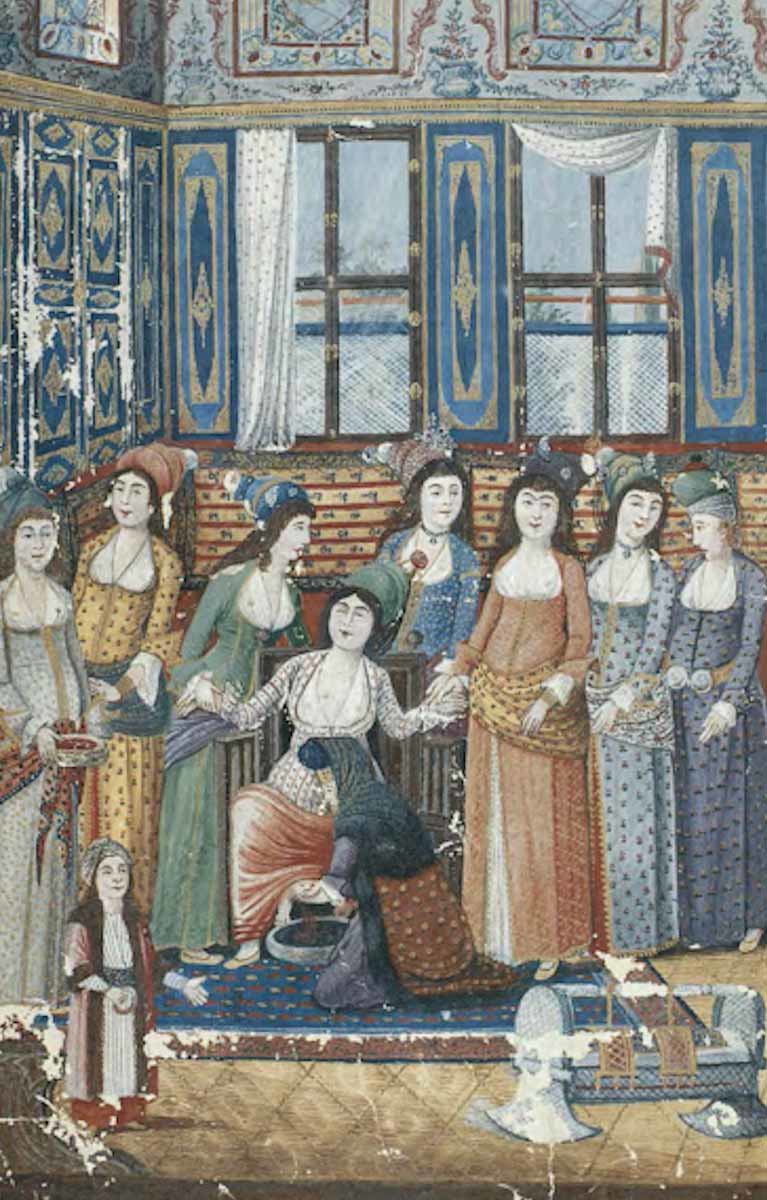
Woman on birthing chair, from Enderuni’s Zenanname (Book of Women), a work about the women of the world and their qualities, 1793.
In early modern Ottoman society, gender set the script for your life from the beginning. Men were formally recognized as heads of the household. Women were expected to become obedient daughters, then dutiful wives, and finally respectable mothers. A woman’s behavior was believed to reflect the honor of her entire family.
Under Sultan Süleyman (r. 1520–1566), the Ottoman state formalized this ideal through the Kanunname, a set of secular regulations that worked alongside Islamic law. These laws treated the household as the basic building block of social order. If a wife committed a serious offense—like adultery—it was not only her sin; her husband could be fined as well, on the grounds that he had failed to maintain order and honor in his home.
Motherhood was central to a woman’s identity. A “good” wife was expected not only to bear healthy children, but to raise them with good manners and morals. Literature from the time reflects this attitude. In the 16th-century Turkish epic The Book of Dede Korkut, the narrator insists, “a girl cannot become a lady unless she has good breeding from her mother.” The mother’s character and guidance were seen as the foundation for the next generation.
So while men held formal authority, women were deeply responsible for the moral and emotional life of the family—quiet power, but power nonetheless.
[block id=”auto-draft”]
Work Beyond the Ideal: Fields, Shops, Baths, and Poems
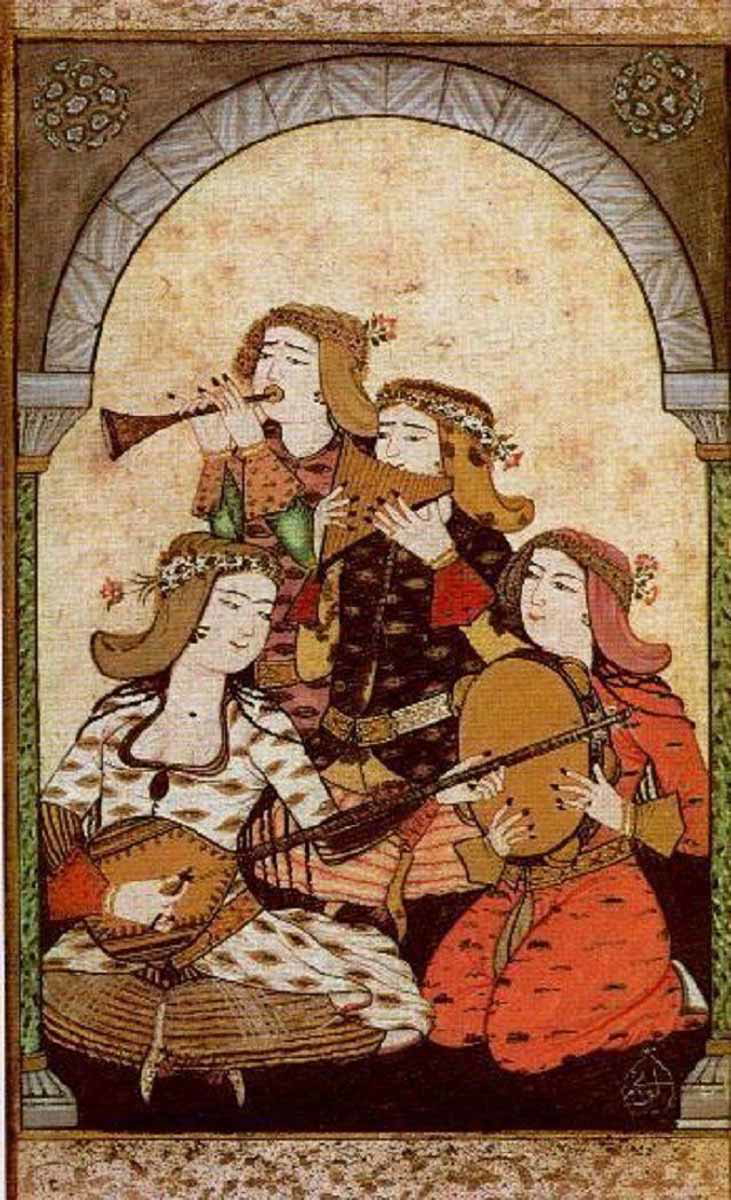
Female musicians, painted by Levni, d. 1732.
Officially, women were not expected to build careers. They were often excluded from craft guilds and rarely offered formal apprenticeships or training. In theory, their main sphere was the home.
In reality, the empire would have struggled without women’s labor.
In rural and nomadic communities, women worked side by side with men. They helped farm the land, herd animals, harvest cotton or hazelnuts, and manage household production. Their work was essential to local economies and survival.
In towns and cities, many women worked as servitors: maids, washerwomen, wet nurses, personal attendants, and domestic servants. They found employment in elite households, public baths, and hospitals. Some professions, like midwifery, nursing, weaving, and embroidery, were dominated by women. These skills could be passed down from mother to daughter, creating female networks of expertise.
European visitors often noticed this. The 16th-century French traveler Pierre Belon observed Ottoman women selling their handmade goods in markets. They were not simply shut away at home; they were visible participants in the economic life of their cities.
There were also women whose work brought them into the realm of ideas and culture. Some taught in primary schools for girls. Others became respected poets at court. Mihri Hatun (d. 1506) and Ayşe Hubbi Hatun (d. 1590) both gained recognition as literary figures and were patronized by powerful patrons, including sultans.
Ayşe Hubbi Hatun, born into an elite family close to Sultan Süleyman, was educated in the palace and later became a lady-in-waiting and confidante to the future Sultan Selim II. Her poetry quietly challenged misogyny, with lines like:
“Being feminine is no shame to the name of the sun… Being masculine is no glory to the crescent moon.”
In other words, she refused the idea that greatness was a male-only trait.
Women in Medicine: Cutting Through Gender Walls
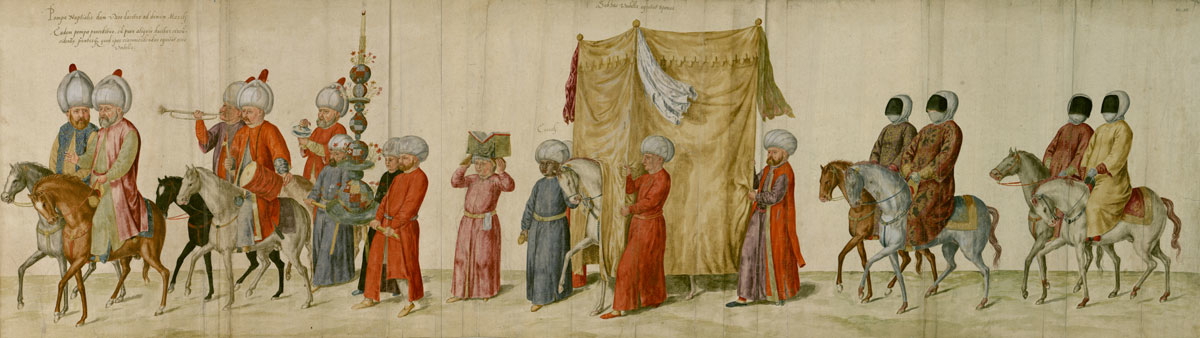
Wedding procession, by Lambert de Vos, ca. 1574.
Medicine was another field where some women pushed past gender boundaries.
Saliha Hatun, a physician practicing in Istanbul in the 1620s–30s, left behind consent forms documenting her work. These records show that she performed surgeries—hernia operations, tumor removals—primarily on male patients. Strikingly, no women are listed among them. In an era when strict gender segregation shaped much of public life, a woman performing surgery on men was highly unusual.
Her career reminds us that Ottoman gender norms were strong but not absolute. With the right skills, connections, or reputation, some women worked far beyond the roles expected of them.
Festivals, Dances, and the Social Stage
Hürrem Sultan Complex, Istanbul.
Women’s public presence was more limited than men’s, but it was far from nonexistent. They took part in major communal celebrations: royal weddings, circumcision festivals for princes, and processions tied to military victories or sultanic ceremonies. Large events might include separate areas or activities for women, but they were still woven into the rhythms of Ottoman public life.
Because women could not perform publicly in mixed-gender spaces, they sometimes held their own gender-segregated entertainment: dances, music, and theatrical shows in female-only settings.
Behind closed doors, the rules relaxed even more. In 1524, when Istanbul’s Italian community celebrated a peace treaty among Italian states, festivities at the Italian ambassador’s home included a ballet and other dances performed by Turkish women.
European observers also recorded women dancers who played with gender presentation. The English historian Thomas Hyde, in his De Ludis Orientalibus (1694), described female dancers called çengi who dressed like men and performed traditional dances such as the zeybek. Even in a society that valued modesty and separation of the sexes, spaces for creative performance and play existed—and women claimed them.
[block id=”related”]
Women as Patrons of Art and Architecture
If visibility in the street was restricted, visibility in stone was another matter.
Powerful women poured money into building projects that transformed cityscapes. They typically founded religious and charitable complexes—mosques, schools, soup kitchens, hospitals, dervish lodges—rather than secular buildings. But these complexes were highly public, and they carried the patron’s name.
This kind of patronage served several purposes at once:
it signaled piety and generosity,
it gave the patron lasting fame,
and it asserted their status in a world where they might rarely be seen in person.
Hürrem Sultan, the famous wife of Suleyman the Magnificent, commissioned the Haseki Hürrem complex in Istanbul around 1540. It included a mosque, religious schools (medreses), a hospital, a bathhouse (hamam), and a soup kitchen. It was both a spiritual center and a social welfare hub—funded, shaped, and named by a woman.
Other royal women extended their influence far beyond Istanbul. Rabia Gülnüş Sultan (d. 1715), consort of Mehmed IV and mother of two sultans (Mustafa II and Ahmed III), founded soup kitchens, pious foundations, and hospitals, including facilities for pilgrims in Mecca. After the Ottoman conquest of Chios in 1695, she converted a church into a mosque and had a fountain built, providing clean water to the area.
These projects were acts of faith, but also of political communication: they announced, in stone, that royal women were forces to be reckoned with.
Respectable, Visible, “Unruly”
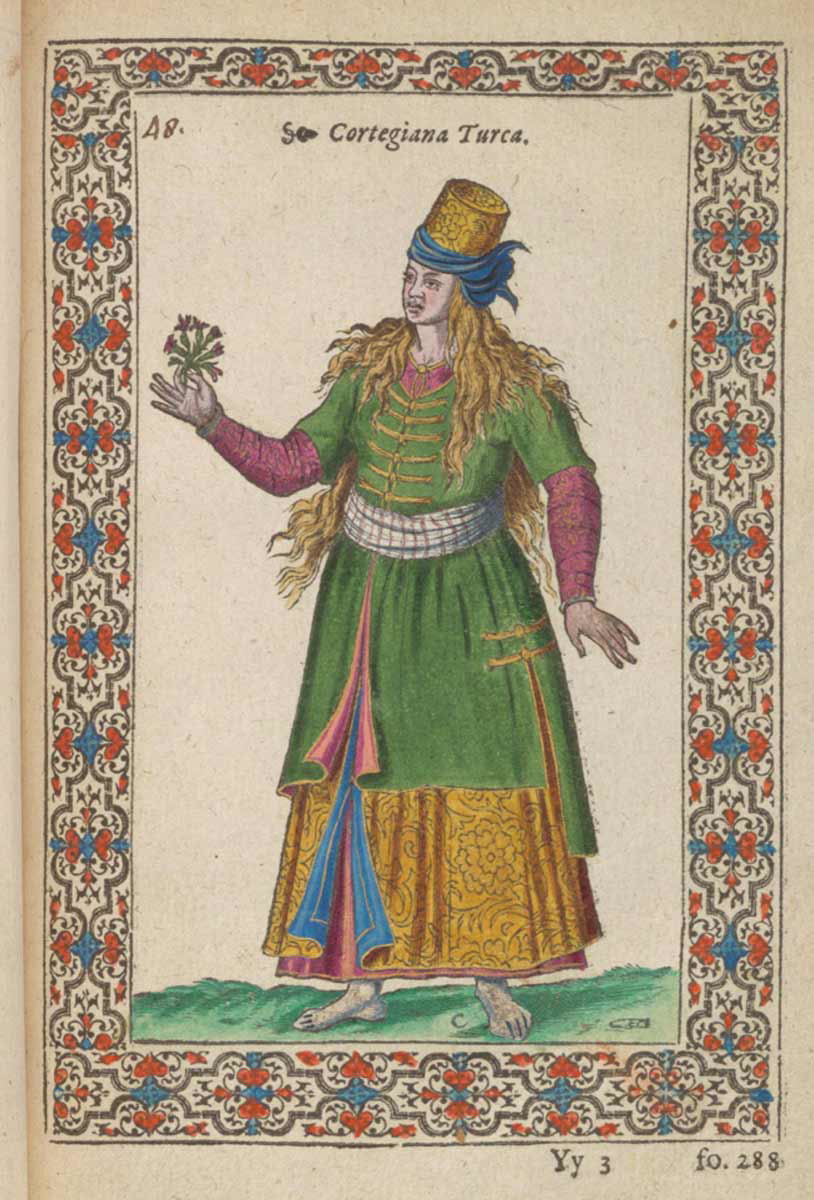
Turkish prostitute, from Travels in Turkey, by Nicolas de Nicolay, circa 1578.
Ottoman etiquette linked female respectability to limited public visibility. For elite women in particular, the ideal was a life lived veiled, attended by servants, and largely confined to the home and carriage. A woman seen too often in public spaces risked gossip and damage to her reputation.
Yet ideals are one thing; survival is another.
Rural women simply did not have the option of seclusion. Fetching water, washing clothes, tending fields, going to the mill—these tasks made them very visible. Their honor was measured differently: by hard work, family contributions, and adherence to community norms rather than strict invisibility.
Romani (Gypsy) women were especially present in public life. They followed the moral codes of their own communities and could be seen dancing, selling goods, and moving freely in the streets, often without veils. Their visibility, while sometimes criticized by outsiders, shows how Ottoman society contained multiple overlapping value systems.
There were also women whose work fell on the wrong side of the law. Prostitution existed and was widely practiced, even though it was officially condemned. Women found guilty could be fined or exiled. Simply being accused was enough to stain a woman’s name.
However, women were not powerless in the face of slander. Those accused of prostitution could sue their accusers in court. If the accusations proved false, the accuser faced a heavy fine. Honor was a communal concern, but women also had legal tools to defend their own.
Queens, Concubines, and the Politics of the Harem
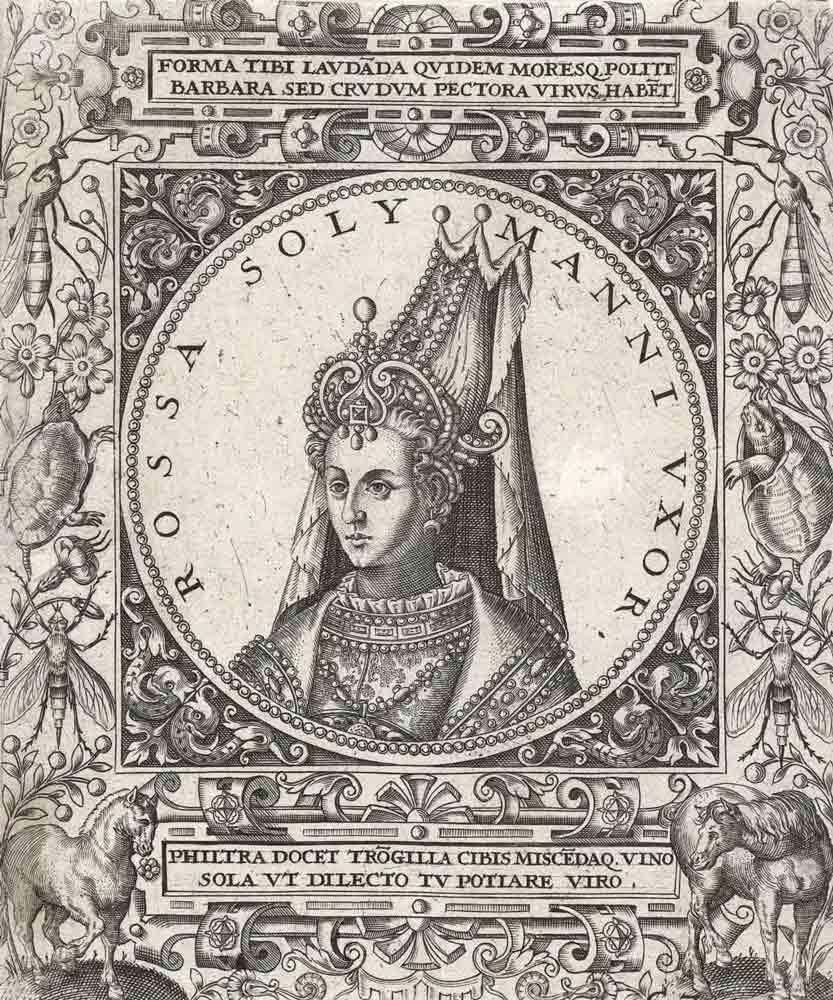
Imagined portrait of Hürrem Sultan, by Johann Theodor de Bry (1561-1623), circa 1590s
At the top of the social hierarchy, women’s lives looked very different—but they were still shaped by the same tension between restriction and power.
In the early Ottoman centuries, sultans often married princesses from rival dynasties, such as the Byzantines. These marriages forged political alliances—and entangled Ottoman rule with external noble families. By the 16th century, as the empire grew dominant across Anatolia and the Balkans, that strategy changed. Instead of marrying princesses, sultans increasingly took concubines.
Concubines were enslaved women, many captured or purchased through the Crimean slave trade. This system allowed sultans to have children without tying themselves to powerful local families. The mothers of princes were part of the imperial household, not external dynasties that might later claim territory or influence.
These palace women were, in some ways, more restricted than many free women in the empire. Their movements were controlled, and when they traveled it was usually in enclosed carriages that protected them from public view. For much of Ottoman history, there was also an important rule: a concubine was supposed to bear only one son. When the boy reached adolescence and was sent to govern a province as a training step toward possible succession, his mother went with him. She served as his advisor, the sultan’s eyes and ears, and the manager of his household and court.
This system changed dramatically under Suleyman I. Suleyman broke precedent by legally marrying his concubine Hürrem, having several sons with her, and keeping them in Istanbul instead of sending them away. This helped pave the way for a new kind of female political role: the valide sultan, or queen mother.
The valide sultan was arguably the most powerful woman in the empire. She managed the harem, had enormous influence over the selection and promotion of concubines, and often advised the sultan directly on matters of state. In some periods, especially the so-called “Sultanate of Women,” queen mothers were central players in Ottoman politics.
Life Inside the Harem
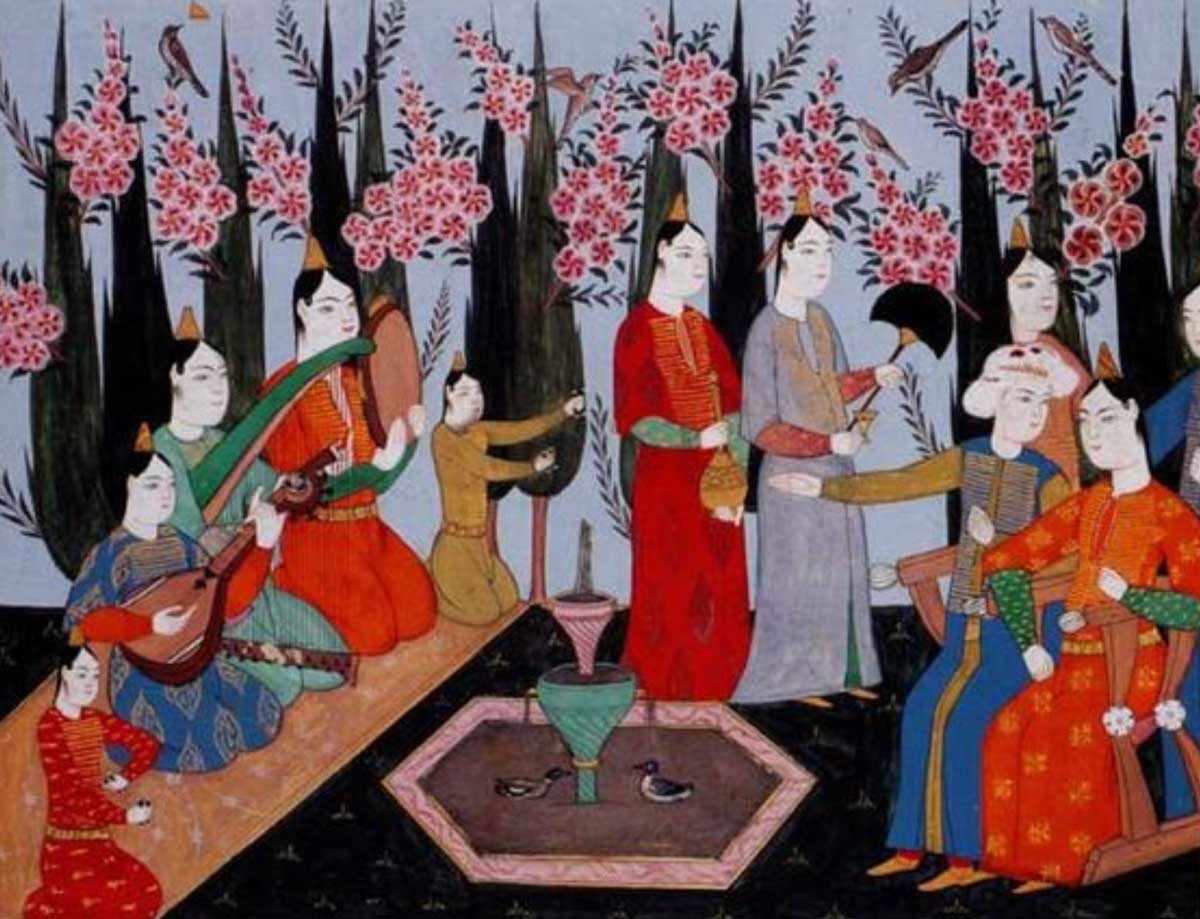
Women of the harem, in the Album of Sultan Ahmed I, circa 1610. S
The imperial harem is often imagined as a place of idle luxury. In reality, it functioned as a highly organized “court within the court.”
Women there held specific roles:
some managed finances,
others oversaw household logistics,
others educated younger women or coordinated ceremonies.
Princesses and other royal women, raised in the harem, were often married off to high-ranking officials—grand viziers, provincial governors, or foreign princes. They then moved to their own palaces and households. Many continued to wield considerable influence. Mihrimah Sultan, daughter of Suleyman and Hürrem, is a well-known example. Even after marriage, she remained a political advisor and financier for her brother Selim II, lending him enormous sums of money (one famous loan was 50,000 gold coins).
Below these elite figures were the many women who kept the harem running: sewing and embroidering clothes for palace pages, cleaning and maintaining living spaces, and caring for children. Wet nurses (daye) held particular prestige. Those who nursed princes were sometimes able to found their own mosques with inscriptions naming their rank—an honor not all royal mothers managed to achieve.
Because men were barred from freely entering the harem, women often had to fill roles that would elsewhere be done by men. By the time of Suleyman I, female physicians served the women of the court. Non-Muslim women also played important parts. Jewish women known as kiras frequently acted as go-betweens and business agents for powerful women, handling finances, trade, and delicate political messages. Their privileged access sometimes made them targets of resentment and scapegoating, especially when court finances faltered.
A World of Quiet Power
From village fields to palace courtyards, from market stalls to surgical tables, women in the Ottoman Empire lived under patriarchy—but they were not simply hidden, silent, or powerless.
They:
upheld and transmitted family honor,
raised children who would become sultans, scholars, and soldiers,
worked in fields, markets, baths, schools, and hospitals,
wrote poetry, built mosques, and funded soup kitchens,
danced, taught, advised, healed, negotiated, and sometimes ruled.
Their stories cut across class, religion, and ethnicity. Some lived within strict seclusion; others spent every day in the open air. Some wielded power through a son’s throne; others did so through a needle, a ledger, a legal complaint, or a medical instrument.
To understand the Ottoman world, you can’t just follow the sultan’s footsteps. You also have to trace the lives of the wives and daughters, the weavers and nurses, the poets and patrons—women whose work and choices quietly shaped an empire.