
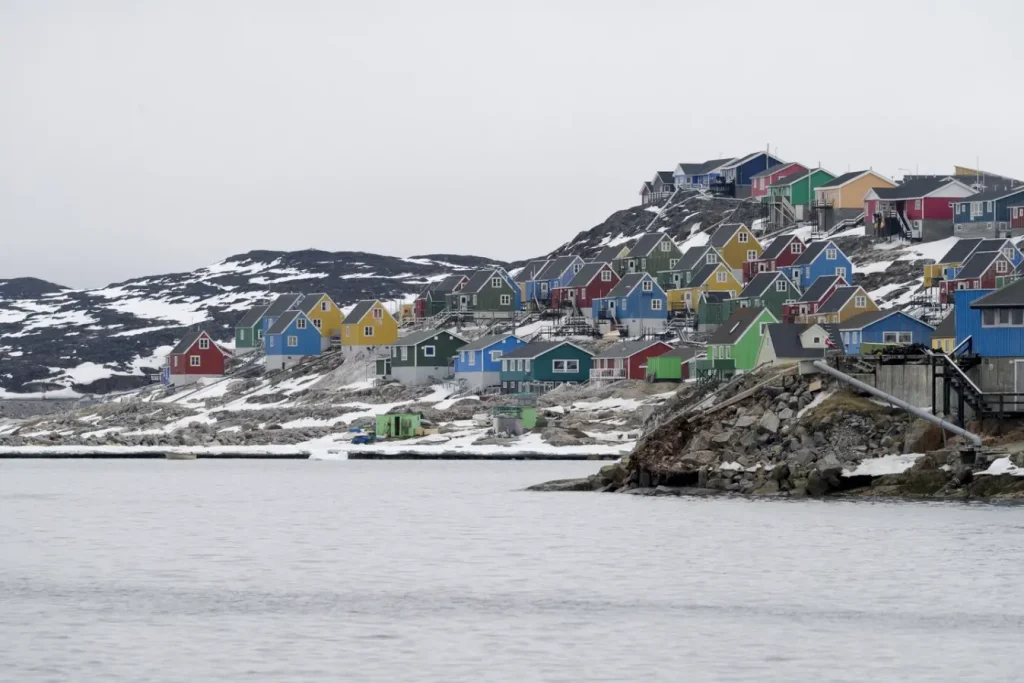
What follows is speculative fiction. Any resemblance to real future events is coincidental. The scenario is plausible—but not inevitable. It’s offered in the hope that seeing the path clearly might help people block it.
It’s January 2028, and the strange part is this: Americans don’t talk about Greenland the way they’d talk about a conquest.
No one landed troops on the beaches. No one signed a grand purchase agreement. There was no dramatic referendum where Greenlanders “chose” Washington over Copenhagen. In any normal history book, there’s no clean moment you could circle and label TAKEN.
And yet, if you watch how power actually works—contracts, logistics, courts, crises, “temporary” arrangements that somehow never end—it becomes hard to deny what happened.
Greenland wasn’t seized.
It was absorbed.
Later, analysts would give the method a name: geo-osmosis—a form of modern imperial reach where sovereignty isn’t imposed with cannon fire, but with function. You don’t need to own the land on paper if you control the ports, the fuel, the fiber lines, the emergency response, the procurement chain, the security training, and the legal loopholes that make all of that feel “normal.”
This is the story of how Greenland fell—quietly, politely, and in plain sight.
From trolling to truth
The world first heard the idea years earlier, back when it sounded like a punchline.
In 2019, Donald Trump had publicly flirted with the notion of “buying” Greenland. Denmark and Greenland responded with a firm, almost bored refusal: not for sale. Most diplomats treated it like another Trump oddity—something between a headline-grab and a reality-TV stunt.
But there had always been a certain logic in Trump’s imagination: territory as a trophy, geography as branding. Greenland, he liked to say, was “a big real estate deal”—a legacy purchase, an Alaska-style moment that could carve his name into the myth of American expansion.
When his second term began, the idea returned—only now it came dressed as strategy.
The public argument had three pillars:
- Resources: Greenland’s rumored bounty—oil and gas potential, and the kinds of minerals every serious power wants for the next industrial era.
- The Arctic: more reach, more radar, more leverage in the north as ice recedes and shipping lanes open.
- Countering rivals: block China and Russia from gaining influence in a place Washington increasingly described as “critical to national security.”
Denmark, trying to be practical, offered a buffet of concessions short of sovereignty: more basing access, more security cooperation, more investment alignment, more of everything that could satisfy the “strategic” goals without touching the one red line.
Trump refused.
That’s when it became clear Greenland wasn’t simply a security question. It was the first tile in a larger mosaic of territorial fantasies—Canada, the Panama Canal, even distant strips of land that appeared in speeches like props in a show.
The old question—is he serious or just trolling?—stopped being interesting.
Because serious people around him started building a plan.
support our project
At History Affairs, we believe history belongs to everyone.
Your contribution helps us keep this global archive open, free, and growing — so people everywhere can learn from the past and shape a better future.
Absorb and conquer
The template didn’t come from nineteenth-century empires. It came from something closer to the present: the age of sanctions, “humanitarian” deployments, and gray-zone operations.
Intelligence agencies were told to map influence networks in Greenland and Denmark: who was ambitious, who was resentful, who was persuadable, who could be elevated. Quietly, the U.S. began treating Greenland less like a partner of a NATO ally and more like a political terrain.
But the White House team understood an obvious risk: a blunt military move against Denmark—an ally—would trigger backlash and potentially fracture NATO in a way even Washington couldn’t manage.
So they went softer.
They went smarter.
They looked at Greenland and saw fragility:
- A population around 56,000—small enough that elite capture didn’t require many hands.
- Vast distances, scattered coastal settlements, thin infrastructure.
- Limited roads, limited redundancy, limited institutional depth.
- A long history of resentment toward Copenhagen’s paternalism.
- A simmering independence movement that could be steered, flattered, and funded.
Greenland didn’t need to be conquered.
It needed to be made dependent.
In May 2026, Washington announced what sounded like generosity: a $10 billion “strategic development initiative”—infrastructure upgrades, resource development, capacity building, resilience, all the right words.
The trick was that the money didn’t arrive as a single, obvious American takeover. It arrived like a swarm of helpful professionals:
- development consortiums
- disaster-response teams
- NGOs
- consultants
- “Arctic energy forums”
- training missions
- connectivity projects
Many wore civilian suits and spoke in soft bureaucratic verbs: coordinate, enhance, partner, support. Many had loose ties to pro-Trump donors or U.S.-funded pipelines that made deniability easy.
They didn’t invest in Greenland as one country-like unit.
They invested municipality by municipality.
Coastal towns received broadband. Airstrips were expanded. Clinics got upgrades. Roads were improved in places that mattered for logistics and extraction. Local officials were flown out for “leadership fellowships.” Small media outlets received grants that somehow always came with American advisors.
None of it came with overt political conditions.
But it came with technical agreements, memorandums, procurement rules, maintenance contracts—little strings you don’t notice until you realize you can’t breathe without them.
The consent problem—and how to route around it
The American planners understood something crucial: Greenlanders didn’t want this.
Even when U.S. investment surged, most residents remained hostile to the idea of becoming American—fearful for their culture, their autonomy, their environment, and yes, their future inside a chaotic U.S. system.
So Washington did not pursue mass persuasion.
It pursued circumvention.
You don’t need 56,000 people to clap. You need a smaller number of decision-makers to sign. You need a public tired enough, distracted enough, cynical enough, that outrage becomes background noise.
So the effort turned toward shaping the political class:
- create competing factions
- reward “pragmatists”
- isolate voices warning of cultural erosion
- inflate the idea that Denmark is the real colonizer
- frame U.S. patronage as liberation
It wasn’t romantic. It was procedural.
It was boring in the way real power often is.
Fealty follows function
The decisive phase didn’t arrive with a battle.
It arrived with breakdowns.
In late 2026 and early 2027, Danish resupply flows began to fail in small, maddening ways:
- shipments delayed
- ports slowed
- inspections multiplied
- fuel became erratic
- medical supplies bottlenecked
- bureaucratic “miscommunications” multiplied
At the same time, Greenland experienced a string of unexplained outages—electricity flickers, Internet disruptions, sudden system failures. Nothing dramatic enough to look like an attack. Just enough to make local governance feel permanently off-balance.
Municipalities did what municipalities always do when they’re desperate: they took help from whoever could deliver it fastest.
The Americans could.
So “temporary” emergency logistics hubs appeared. Humanitarian justification opened doors. Contractors arrived to “assist” with security and continuity planning. Coordination offices became permanent. The line between aid and control blurred into invisibility.
There were already U.S. troops at Pituffik Space Base in the north. Now the footprint expanded under the language of crisis response. And once you accept someone else’s logistics, you start accepting their rules.
A cluster of Greenlandic lawmakers formed a parliamentary bloc with a bright name—something like a “Sovereign Future” caucus—signaling openness to “alternative partnerships.”
One adviser reportedly described it with chilling simplicity: build the ties first, let sovereignty follow.
By early 2027, Greenland lived in a twilight state:
- formally Danish
- functionally American
Not through flags.
Through supply chains.
Law as the final tool
Turning de facto control into de jure legitimacy is always the hard part. Not because law is sacred, but because law is useful: it converts power into paperwork that outsiders hesitate to challenge.
So Washington’s lawyers built a framework from precedent, selectively arranged like a legal collage:
- Greenland’s “right to self-determination”
- historical examples of past territorial arrangements
- a “transition” logic that sounded temporary but wasn’t
- language that implied invitation without requiring a clean vote
They avoided a national referendum, because they knew it would fail.
Instead, they encouraged Greenland’s parliament to declare a form of provisional autonomy, and Washington offered recognition “in principle”—a phrase engineered to be full of promise and empty of responsibility.
A letter, signed by pro-American officials in July 2027, became the keystone. The United States used it to claim it had been invited to expand security presence in Nuuk—even though no clear national mandate existed.
In October 2027, Greenland’s parliament announced an interim sovereignty process. U.S. “civil-military liaison offices” appeared in Nuuk and other major towns. Flags went up. The language stayed polite. The reality hardened.
Negotiations began for a compact of free association—the kind of arrangement that sounds like partnership until you read the details about defense authority, foreign affairs, and economic zones.
And then the most important shift happened:
Greenland’s sovereignty stopped being a question of identity and became a question of administration.
Who runs what.
Who pays.
Who supplies.
Who protects.
Who decides in emergencies.
“We express grave concern”
Denmark erupted. It called the move a hostile act and yanked its ambassador. European leaders condemned it in the familiar vocabulary of modern impotence: deeply concerned, closely monitoring, urging restraint.
But Denmark lacked the leverage to reverse facts on the ground. The EU—already strained, cautious, divided—hesitated to escalate against Washington.
Russia flew patrols near Greenlandic airspace, while Chinese media denounced the United States as a rogue imperial actor—denouncing loudly, observing carefully.
Inside the U.S., the move split the public, but the administration’s media engine did what it always did: it turned complexity into spectacle.
A campaign rolled out with a glossy name—“America’s Frozen Frontier.” Cable segments ran with AI-generated images of Greenlandic children waving U.S. flags. Rallies revived the chant: Make Greenland Great Again. The Trump Organization teased fantasies of mega-resorts and luxury “winter frontiers.”
It didn’t matter that most Greenlanders remained uneasy or opposed. They could protest—but Washington was delivering services, salaries, connectivity, fuel, and “security.”
And once people depend on your system to live normally, they can oppose you forever and still be trapped inside your reach.
Denmark filed a case in international court. Procedure swallowed it. Years passed. Nothing moved.
Meanwhile, contractors kept building.
And Washington declared victory.
The cold beneath the ice
Later, historians wouldn’t study Greenland as a one-off stunt. They’d study it as a blueprint.
Not because it was the first attempt at modern influence. But because it showed something many leaders secretly believed and few dared to demonstrate so openly:
You don’t need to seize territory if you can make it unable to function without you.
Geo-osmosis became a model others imitated. Observers drew lines from Greenland to later “invitations,” “interim transitions,” and “emergency partnerships” elsewhere—moments where sovereignty wasn’t conquered but dissolved.
And the most unsettling lesson wasn’t about Trump or Greenland.
It was about the international system itself.
Norms only matter when someone enforces them.
Outrage only matters when it carries cost.
Law only matters when it meets power.
In the twenty-first century, the border isn’t always crossed by tanks.
Sometimes it’s crossed by fiber cable, fuel contracts, and a friendly team of advisors who show up during the worst week of your life—then never leave.

support our project
At History Affairs, we believe history belongs to everyone.
donateYour contribution helps us keep this global archive open, free, and growing — so people everywhere can learn from the past and shape a better future.
know the present
Defense Tech Needs the State, Not Less of It
Trump Era or The New Imperial Age
America First, Venezuela, and the Trap of Old Habits
Why the AI Race Has No Winner
reading more
The Decembrists: Russia’s First Liberal Revolt and the Winter It Failed
How the Tudors Built Status
King Octa of Kent and the Clockwork of Arthur’s Age
York: A Walk Through 1,000 Years of Medieval History
Pope Leo X Who Helped Ignite the Reformation
Exploring the Shadows: A Review of Amedeo Feniello’s “Naples 1343”
The Subapostolic Age: Navigating Christianity’s “Tunnel Period”
Egypt’s 18th Dynasty: The Rise and Fall of Its Greatest Pharaohs
Were the Mongols Really Religiously Tolerant?
Who Were the Edomites? The Long Rivalry Between Israel and Edom
Four Great Cities of the Americas Before Columbus
Battle Sites of King Arthur Against the Anglo-Saxons