
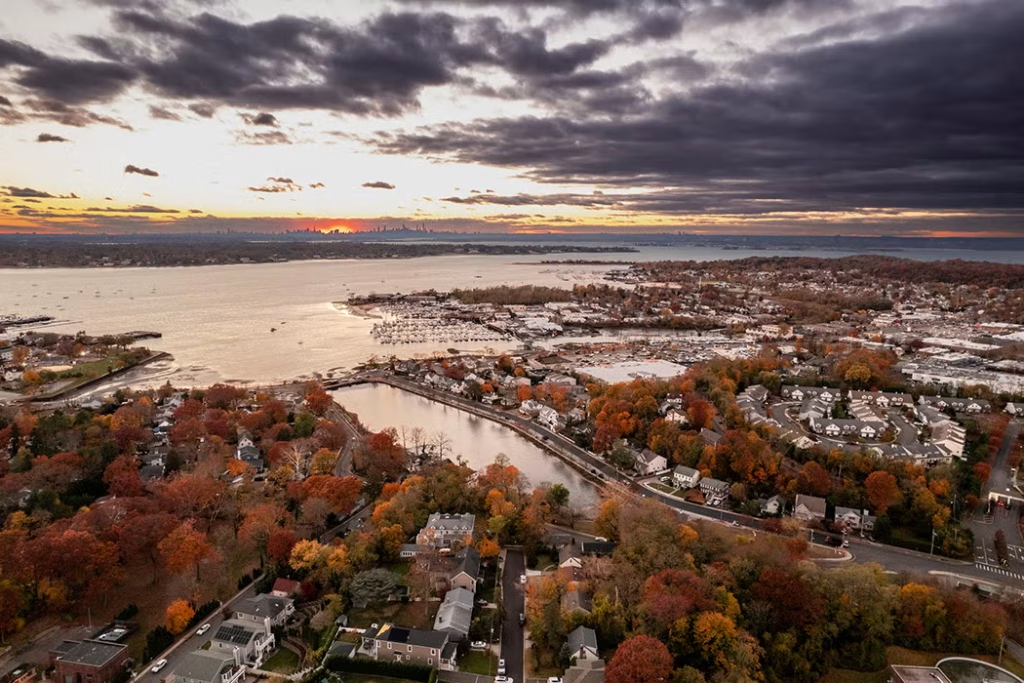
The rivalry between old money and new money might feel like a Twitter-age obsession, but it’s been baked into the American story from the start. No novel captures that tension more perfectly than The Great Gatsby, and no place embodies it quite like the strip of land where Fitzgerald set his tale: Long Island.
On one shore, you have those who built fortunes fast and loud. On the other, those who inherited theirs and move quietly behind stone walls and clipped hedges. West Egg versus East Egg. Great Neck versus Sands Point. New wealth staring across the water at old wealth, desperate to be seen and never quite accepted.
Long Island isn’t just a backdrop for that drama. It helped create it.
The Real West and East Egg
A hundred years ago, readers first met West Egg and East Egg — thinly disguised versions of Great Neck and Sands Point on Long Island’s North Shore. Fitzgerald and Zelda lived in Great Neck in the early 1920s, right in the middle of a boom: self-made millionaires throwing up showy mansions, buying fast cars, and packing their nights with jazz and gin.
Fitzgerald knew these people. He watched them arrive, build, and perform their new status. Across the water were the older, quieter estates where families like Tom and Daisy Buchanan’s fictional counterparts had been rich long before the Jazz Age.
When The Great Gatsby came out in 1925, early reviewers immediately framed Jay Gatsby as a kind of American Don Quixote on Long Island: a rough, awkward romantic trying to live out a dream among people who don’t deserve him. He was “a Yankee Quixote,” “a rough diamond,” a true romantic wandering through a world of careless rich. Long Island wasn’t just scenery; it was the logic of the story.
If you were rich and living where Fitzgerald placed Tom, Daisy, Nick, and Gatsby, you were among the most privileged people in the United States. But those manicured lawns and marble staircases grew out of a much older, rougher history.
Before the Mansions: Land, Conflict, and Corn
Long before Gatsby’s parties, Long Island was home to Algonquian-speaking peoples such as the Montaukett, Shinnecock, and Matinecock. They lived in semi-permanent villages, fishing, hunting, and farming the island for centuries.
In the 1600s, Dutch and English settlers began carving out farming and fishing communities. Conflict followed, as it usually did: colonists pushing in, Indigenous communities pushed out. Over time, Dutch and English ways of life took over, but daily existence for settlers was anything but glamorous.
Still, there was a kind of harsh beauty in that early colonial world. One 1930s account paints a picture of mothers inventing new dishes out of pumpkins and Native crops like corn. People crushed corn in heavy mortars to make “samp,” a staple in autumn. Sailors joked that in the fog they knew they were nearing Long Island when they heard the steady pounding of those mortars drifting out from shore.
If meat was scarce, the answer was simple: carrots, pumpkins, turnips, and clams. Life was hard, but it was also full and resourceful. While later generations would come to Long Island chasing status and sea breezes, the first arrivals came for survival.
A Battlefield for a New Nation
After the English took control from the Dutch, British rule on Long Island went largely unchallenged for more than a century. Then came the American Revolution — and one of its biggest early tests.
In 1776, the island became the stage for the largest battle of the war: the Battle of Long Island, also known as the Battle of Brooklyn. The British won decisively and captured both Long Island and New York City.
But they missed their moment.
If the British had used their navy to pin George Washington’s army against the water, the Revolution could have ended there. Instead, their fleet stopped short, anchoring in Flushing Bay and failing to block the escape route. Washington slipped his army across the river under cover of night. The war, and the American experiment, survived.
Gatsby’s glittering shoreline, a century and a half later, rests on land where the entire future of the country nearly collapsed.
From Farms and Whales to the Gold Coast
In the early United States, Long Island was practical before it was glamorous. Farms on the island supplied nearby New York City. Sag Harbor became a whaling port, sending ships out into distant oceans.
Everything changed with the arrival of the Long Island Rail Road in 1837. Suddenly, the island was more accessible. Wealthy New Yorkers started seeing it not just as farmland but as a summer escape. Over time, especially along the North Shore, estates and mansions began to rise.
By the late 19th and early 20th centuries, the “Gold Coast” had taken shape. Industrialists and entertainers built sprawling properties overlooking the water. Eddie Cantor, a famous actor and comedian, played table tennis with his family on the lawn of a grand Long Island home in the 1920s — the same decade Fitzgerald set Gatsby. It was a world of private beaches, tennis courts, motorboats, and endless parties.
Politically, this wealth helped turn Long Island into solid Republican territory. Many residents supported Herbert Hoover against Franklin D. Roosevelt in 1932. Local business leaders praised the beauty and convenience of life in places like Great Neck, speaking glowingly of suburban calm and proximity to the city. Notably, they barely mentioned the Great Depression, even as it crushed lives elsewhere.
Roosevelt and poorer residents saw something different. Through the New Deal’s Works Progress Administration, the federal government built roads, sewers, parks, beaches, and public buildings on Long Island, and preserved historic sites. The island’s most privileged corners might have felt insulated, but the larger region was being reshaped by federal spending and public works.
Suburbia, Localism, and the Drawbridge Mentality
After World War II, Long Island boomed again. Factories, shops, and later service industries spread across the island. Suburbs multiplied. Highways stitched everything together. For many Americans chasing a house, a yard, and a new start, Long Island looked like a dream.
But the dream had fault lines.
From the beginning, Long Island’s settler culture put a high value on autonomy and self-reliance. In the 17th century, isolated communities depended on local government and local effort. That “we take care of our own” instinct never quite went away.
By the 1960s and 1970s, this blended with another force: white flight. Many middle-class and affluent white families left New York City as neighborhoods changed, especially along racial lines, and moved to places like Long Island. Those experiences hardened attitudes. Suburban self-government became a fortress, and the metaphorical drawbridge went up.
“Never again,” many residents thought, remembering what they perceived as urban decline. Small changes — new neighbors, new policies, new developments — could feel like the first step toward irreversible transformation. Localism wasn’t just a principle anymore; it was a defensive shield.
That tension between mobility and local control, between people moving in and residents pulling away, created what some scholars in the late 1970s called a “regional crisis.” The island was tied economically and socially to the wider region, but politically and emotionally, many communities wanted to remain walled off.
Long Island Now: The Same Dream, New Pressures
Today, Long Island is a mix of commuter suburbs, historic estates, beach towns, and working communities. There are museums and marinas, old whaling ports and outlet malls. The issues on people’s minds include rising sea levels, coastal erosion, and how anyone without a trust fund can afford to live there.
In some ways, not much has changed since Gatsby’s time.
You still have day-trippers drawn by visions of a charming coastal escape. You still have the ultra-rich, building higher fences and better security systems along the North Shore. You still have people looking across the water — or across the highway — at someone else’s life and wondering how to cross over.
Critics of The Great Gatsby have long pointed out that Gatsby’s guests didn’t come only for free drinks and fast boats. They came chasing a feeling: the idea that somewhere in all that glitter was a reality that could complete them, a version of the American Dream they had somehow lost. They were illusions in search of a solid world.
Gatsby himself, for all his criminal money and bad taste, is the only one who really believes in that reality. He thinks he can pull it into being by sheer force: the house, the parties, the shirts, the green light at the end of the dock. He wants the dream to be real so badly that he rebuilds his entire life around it.
Modern Long Island still runs on that tension. Whether it’s tourists posting photos from the East End, commuters dreaming of a bigger house closer to the shore, or billionaires quietly buying another waterfront lot, the pattern repeats.
New money still looks across the water at old money.
People still arrive hoping proximity to wealth will change their lives.
Localism still raises the drawbridge when it feels threatened.
Fitzgerald’s chimera of the American Dream — glittering, intoxicating, always out of reach — still hovers over the island that inspired it. Long Island remains what it was in Gatsby’s day: a mirror held up to America’s deepest desires and its sharpest divides, where the view across the bay is never just about the landscape.

support our project
At History Affairs, we believe history belongs to everyone.
donateYour contribution helps us keep this global archive open, free, and growing — so people everywhere can learn from the past and shape a better future.
know the present
Defense Tech Needs the State, Not Less of It
Trump Era or The New Imperial Age
America First, Venezuela, and the Trap of Old Habits
Why the AI Race Has No Winner
reading more
Ottoman Sultans and Their Vices: Alcohol, Drugs, Women, and Rebellious Princes
The 3 Battles That Decided the Franco-Prussian War
York: A Walk Through 1,000 Years of Medieval History
8 Key Events Shaping Australia
Julius Caesar and the Danger of Punishment Without Due Process
The Clash of Titans: Rome vs. Antiochus the Great
Imperial Cult: When Roman Emperors Canonized
Five Descartes Quotes That Still Sharpen Your Mind
Remarkable Onna-Bugeisha: Warrior Women of Medieval Japan
Trump Era or The New Imperial Age
Five Sartre Quotes That Won’t Leave You Alone
Story of the First Legend Hero: Cadmus