
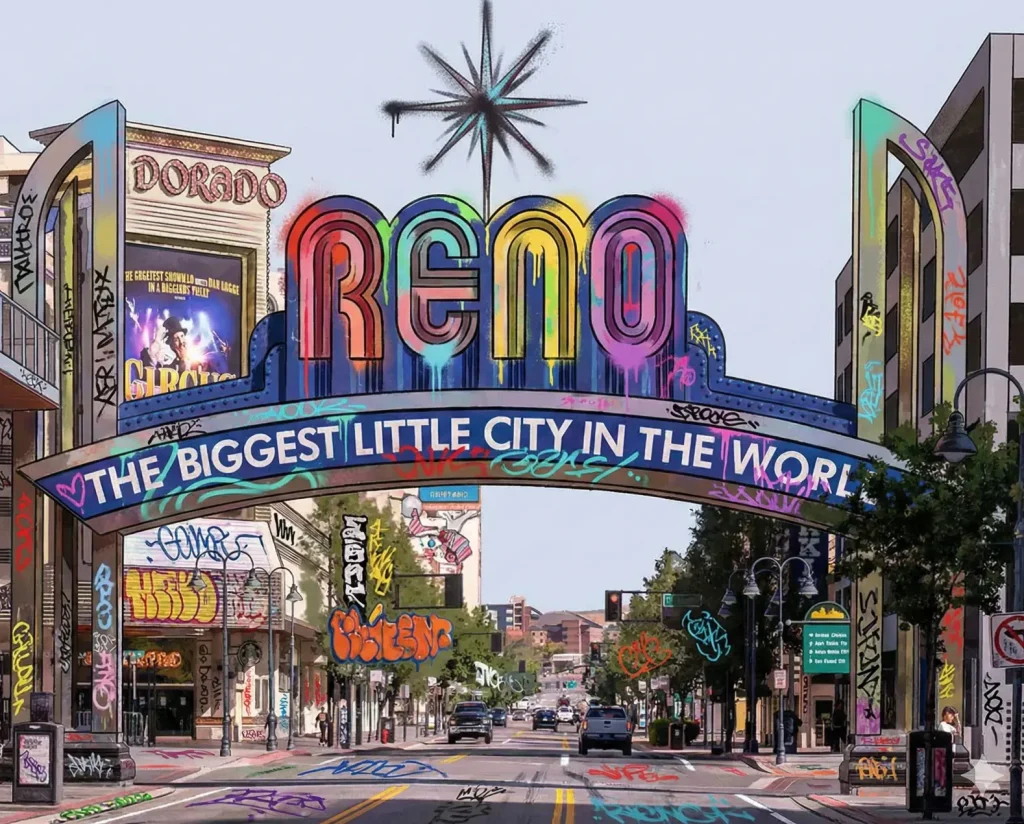
When most people think of Nevada, they picture slot machines, neon lights, and the all-night buzz of Las Vegas and Reno. But behind the casinos and billboards is a state with one of the most unusual and dramatic backstories in the United States: a place of ancient rock art, boom-and-bust mining towns, nuclear tests, and constant reinvention.
This is the story of how a quiet desert land turned into the “Silver State” — and why its future still feels uncertain.
Long Before It Was Nevada
Nevada’s official birthday is October 31, 1864, when it became the 36th state in the Union. But people had been living on this land for tens of thousands of years before anyone drew a border or hoisted a flag.
Near ancient Lake Winnemucca, archaeologists have found what are believed to be the oldest rock carvings in the United States. These petroglyphs – faint lines and symbols etched into stone – are estimated to be between 10,500 and 14,800 years old. Some evidence suggests humans might have been in the region as far back as 20,000 years ago.
We know very little about these earliest inhabitants. Over immense stretches of time, cultures rose, changed, and vanished. Around 700 years ago, the ancestors of the Shoshone and the Northern and Southern Paiute entered the region. Their descendants were the ones who would later greet – or endure – the arrival of Europeans.
“Nevada”: A Spanish Name for a Harsh Land
The Spanish were the first Europeans to reach the region. Like elsewhere in the Americas, they did not recognize Indigenous land rights in any modern sense. By the late 18th century, the Spanish Empire claimed most of North and South America, from the southern tip of the continent to the edges of Alaska.
They gave the area the name Nevada, from the Spanish word for “snowy” or “snow-covered,” inspired by the white-capped mountains in winter. On paper, empires claimed the land. In reality, they made little effort to settle or deeply govern it.
All that changed in the mid-19th century, when the young United States turned its eyes west.
From 1846 to 1848, the United States and Mexico fought the Mexican-American War. Mexico lost badly. The Treaty of Guadalupe Hidalgo forced Mexico to cede a huge swath of territory to the U.S. What is now Nevada passed through several political labels: first part of the Utah Territory, and then, in March 1861, a separate Nevada Territory.
Silver, Mormons, and the Road to Statehood
Even before Nevada was a territory, a few Americans had pushed into its deserts and mountain valleys. But most didn’t stay. The first truly permanent non-Indigenous settlers were Mormon pioneers. Around 1851, they set up waystations along the route to the California gold fields — rest stops for travelers chasing dreams further west.
Nevada’s real population boom began in 1859, with one discovery: silver.
The Comstock Lode, a massive silver deposit, changed everything. Prospectors, merchants, and fortune-seekers flooded in. Carson City had just been founded in 1858 and now quickly became an important center of life and trade for the new territory.
With more people came more attention from Washington, D.C. Statehood became a real possibility. But the timing would tie Nevada’s birth directly to the bloodiest conflict in U.S. history: the Civil War.
Nevada Joins the Union – and Helps Re-Elect Lincoln
There’s a popular myth that Nevada was rushed into statehood so that its mineral wealth could bankroll the Union war effort. In reality, by late 1864, the war was already tilting heavily in the Union’s favor. Silver from Nevada was useful, but not decisive.
What really mattered was politics.
Abraham Lincoln was running for re-election in 1864. The country was exhausted. Casualties were enormous. Peace — even on bad terms — sounded tempting to many.
To make things more complicated, Lincoln’s own Republican Party had split. He led the moderate National Union faction, which wanted to bring the Confederate states back into the Union with firm but not vengeful conditions. On his left flank was General John C. Frémont and the Radical Democracy Party, who wanted harsher punishment for the South. On the other side stood Democrat George B. McClellan, who favored a much softer line toward the former Confederates.
Frémont eventually withdrew, but Lincoln still faced a serious challenge.
Nevada, heavily pro-Union and strongly Republican, promised a small but symbolically important boost. Making it a state meant:
- Extra electoral votes for Lincoln.
- Another sure vote in Congress for Lincoln’s anti-slavery measures.
So on October 31, 1864, Nevada became the 36th state. A few days later, Lincoln was re-elected president. Over the next years, Nevada’s borders expanded, taking its southern tip from Arizona—a territory whose pro-Confederate leanings during the war left its protests largely ignored.
Boom, Bust, and the Fight for Survival
After the war, Nevada’s fortunes rose and fell with the metals under its soil.
In the 1870s, the federal government began nudging the country toward the gold standard, even before it was officially adopted. That shift quietly crushed Nevada’s silver miners. As gold rose in importance, silver’s value slipped. Mines that had once made fortunes now barely broke even.
Many Nevadans turned to ranching, but the desert climate and unpredictable markets made that a risky way to make a living.
The state’s population shrank. Ghost towns appeared: places where mines had closed, shops were abandoned, and the wind howled through empty streets.
Yet Nevada wasn’t finished. At the turn of the 20th century, new discoveries pulled it back from the brink. Silver was found in Tonopah, gold in a nearby camp that took the name Goldfield, and copper in Ely to the north. These finds reignited the mining industry.
Industrialization and the First World War increased demand for metals. Railroads pushed deeper into the state, and irrigation projects improved agriculture and ranching. For a while, it seemed like the hard times were over.
Then came the Great Depression.
Hoover Dam, Gambling, and the Rise of Reno
Like the rest of the United States, Nevada was hit by the economic crash of the 1930s. But two decisions would change the state’s trajectory and set the stage for the Nevada we know today:
- The legalization of gambling
- The construction of Hoover Dam
Legal gambling turned Reno into a destination city. Tourists came to try their luck at the tables and slot machines, and where money flowed, crime soon followed. Organized crime syndicates moved in, tightening their grip on casinos and other vice industries, including prostitution. (To this day, prostitution remains legal in licensed brothels in ten of Nevada’s 16 counties.)
At the same time, the federal government poured money into Nevada. Per capita, government spending in the state was the highest of any in the country during the Depression. The biggest symbol of this investment was Hoover Dam (originally called Boulder Dam), an enormous concrete barrier on the Colorado River that would provide power and water for vast areas of the Southwest.
Together, legal gambling and massive public works softened the blow of the Depression. Nevadans suffered, but in general they suffered less than many Americans elsewhere.
Las Vegas, the Mafia, and Nuclear Mushrooms on the Horizon
Reno may have come first, but in the early 20th century, southern Nevada began to steal the spotlight.
In 1905, the city of Las Vegas was founded along a key railroad line. An old Mormon fort nearby hinted at the region’s role as a historical crossroads, halfway between Salt Lake City and Los Angeles.
Soon, the pattern seen in Reno repeated itself: gambling, rapid growth, and organized crime. When Hoover Dam was completed in 1936, Las Vegas became its first customer. The dam’s construction also created Lake Mead, turning the desert into a mix of recreation area, engineering marvel, and opportunity.
Gambling, quick divorces, and liberal marriage laws made Las Vegas a magnet for tourists. Hotels, casinos, and nightclubs multiplied. Behind the glitz, mafia bosses carved up territory, laundered money, and fought bloody turf wars. Law enforcement spent decades trying to pry their fingers off the city’s economy.
And then came the nuclear age.
Starting in the 1940s, the U.S. Department of Defense looked at Nevada’s empty expanses and saw something useful: a testing ground. Military bases brought jobs, but the most dramatic changes came from the Nevada Test Site, 65 miles north of Las Vegas.
In the 1950s, the state hosted hundreds of nuclear tests. Many early explosions were conducted above ground. Incredibly, these weren’t kept secret from the public—quite the opposite. The mushroom clouds rising over the desert became a tourist attraction. People flocked to Las Vegas specifically to watch tests from a distance, cocktail in hand, as the desert lit up.
Cleaning Up the Industry and Selling the Dream
By the late 1960s, Nevada’s gambling industry was at a crossroads. The mob still had enormous influence, and the state’s reputation was a mix of glamour and danger.
In 1967, Nevada passed the Corporate Gaming Act. It removed strict financial background checks for corporations seeking gambling licenses. The goal was to attract big, legitimate businesses to invest in casinos and hotels.
It worked. Corporations poured in, slowly pushing mafia money and control out. Over time, especially from the 1990s onward, Las Vegas began to rebrand. Mega-resorts popped up along the Strip: themed hotels, family-friendly attractions, enormous pools, and attractions for people who might never gamble at all.
Nevada leaned fully into the fantasy business – selling images of glamour, luxury, and excitement to millions of visitors every year.
Nevada in the 21st Century: A Shaky Future
By the end of the 20th century, Nevada’s story looked like an American success tale: from empty desert to booming tourist powerhouse.
But the 21st century has brought new storm clouds.
Other states began legalizing gambling, and online betting exploded. Nevada no longer held an almost exclusive license on American gambling. Competition cut into profits and visitor numbers. Tourism – the lifeblood of cities like Las Vegas and Reno – became more fragile.
Then COVID-19 hit.
Before the pandemic, Nevada’s unemployment rate sat around 4%, roughly equal to the national average. Lockdowns and travel bans changed that overnight. In April 2020, Nevada’s unemployment shot up to around 31%, far higher than the national peak of about 15%. Hotels emptied. Casinos went dark. The cities built on visitors suddenly had no visitors at all.
While things have improved since then, Nevada’s recovery has lagged behind much of the country. As of late 2024, the state’s unemployment rate remains the highest in the United States. At the same time, housing and rent costs have climbed, putting extra pressure on young Nevadans trying to build a life there.
The old dream — come to Nevada, work hard, and ride its boom — feels less guaranteed than it did for earlier generations.
The Silver State, Still Being Written
Despite all this, Nevada remains a place of strange, striking beauty: red canyons and salt flats, petroglyphs older than written history, ghost towns crumbling into dust, glittering towers rising from the desert floor.
Its story has always been one of extremes: ancient and futuristic, rich and poor, boom and bust, lawless and regulated. From Indigenous painters carving symbols near Lake Winnemucca to tourists snapping photos on the Las Vegas Strip, people have always come here chasing something — survival, money, reinvention, or just a good time.
What comes next is unclear. But if Nevada’s past is any guide, one thing is certain: it will not stay the same for long.

support our project
At History Affairs, we believe history belongs to everyone.
donateYour contribution helps us keep this global archive open, free, and growing — so people everywhere can learn from the past and shape a better future.
know the present
Defense Tech Needs the State, Not Less of It
Trump Era or The New Imperial Age
America First, Venezuela, and the Trap of Old Habits
Why the AI Race Has No Winner
reading more
Anubis: Guardian of the Underworld and God of the Dead
Nestor Makhno: The Ukrainian Anarchist
Constantine and the Christian Empire
Aelfgifu: Queen of England and Denmark
North African Campaign: Fire on the Desert
The Epic Italian Campaign: From Mussolini’s Downfall to the Liberation of Rome
Home Front’s “Enemy”: A Wartime Tale of Suspicion and Betrayal
America’s Most Beloved Urban Parks
Sir. Lancelot: Arthurian Legend’s Greatest Knight
Derek R. Peterson’s A Popular History of Idi Amin’s Uganda: A Review
Pope John XII: A Teenage Pontiff and the Dark Legend of the Papacy
Are the Speeches in Thucydides’ History Authentic or Invention?