
In 1563, a servant named Elizabeth Flynte walked into the church court of the Lichfield diocese and did something that feels oddly modern: she timestamped a scandal using whatever time anchors would make sense to the people listening.
A man, she said, “come in here this night”, stayed four or five hours, and left around three in the morning. Clear enough. But when she tried to describe which nights, she didn’t reach for a neat date like “September 29th” or “October 23rd.” Instead she stitched together a patchwork of time markers her community would recognize:
- “about Michaelmas last”
- “about a month or 3 weeks then next following”
- “about Lenton Fayre last past”
Clock time. Church time. Fair time. All in one breath.
And the court accepted it—because early modern England didn’t run on one single, universal calendar in the way we imagine today. People lived inside overlapping systems of time, and the courts depended on those shared understandings to decide what happened, when, and whether witnesses were talking about the same event.
The courts that judged your morals—and needed your timeline
These were church (consistory) courts, held in cathedrals and large parish churches. They weren’t small-town gossip circles, but they dealt with intensely personal issues: sexual misconduct, defamation, failure to follow church rules, plus tithes and probate disputes.
The tricky part? The Lichfield diocese was huge—spanning places like Shropshire, Derbyshire, Staffordshire, and parts of Warwickshire. Judges and lawyers moved around. Witnesses came from different parishes, with different rhythms. Yet everyone had to communicate a timeline well enough that the court could test stories against each other.
So people testified using a mix of precision and familiarity, depending on what they had—and what they believed the listener would understand.
“Summer last past was twelvemonth”: vague, but not useless
Some witnesses spoke in broad seasonal strokes.
In 1590, a clergyman named Thomas Kynston described people refusing to contribute to church upkeep “in summer last past was twelvemonth.” Translation: the summer before last.
That’s not a date. But it’s a workable bracket. In a world where many people didn’t track days on paper, “two summers ago” could be a solid reference point—especially if multiple people remembered the same episode.
When a festival becomes a calendar tool
Other witnesses got sharper by anchoring time to religious celebrations that practically everyone knew.
Also in 1590, William Lucas described hearing defamatory words spoken “upon Monday in Whitsun week last past late in the evening after supper.”
Look at what he’s doing:
- Whitsun week narrows it to a known religious season.
- Monday pins down a specific day inside that week.
- “after supper” adds a social clock that everyone in the room could picture.
That last part matters. “After supper” wasn’t a casual throwaway. In a community, meal times were a kind of shared schedule. People knew roughly when supper happened in their world, in their season, with their daylight. Courts didn’t always need a minute hand—sometimes they needed a human routine.
support our project
At History Affairs, we believe history belongs to everyone.
Your contribution helps us keep this global archive open, free, and growing — so people everywhere can learn from the past and shape a better future.
Harvest time: the countryside’s most common timestamp
If church festivals were national anchors, agricultural work was the local backbone of timekeeping.
Witnesses often dated crimes by linking them to cyclical tasks:
Sheep shearing. Ploughing. Sowing. And most of all: the harvest.
But here’s where it gets interesting: even “harvest” wasn’t a single, fixed thing.
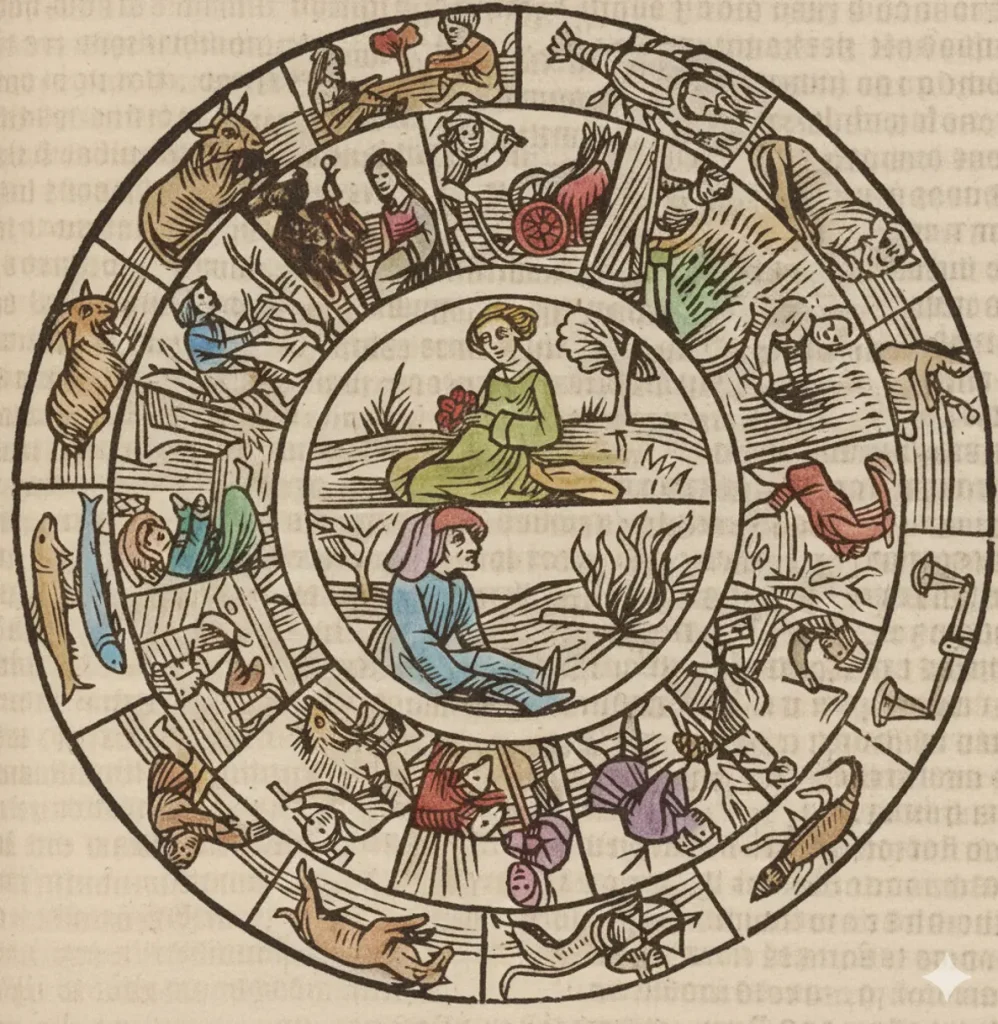
Some almanacs, using the liturgical calendar, tied the start of harvest to Lammas Day (1 August)—a day associated with the first wheat cut and bread made from the new grain. Yet plenty of imagery of the “Labours of the Months” (stained glass, carvings, manuscripts) linked harvesting more strongly to September.
So when a witness said “during harvest,” the court still had to ask: Harvest as in early August wheat cutting? Or harvest as in September labour? The phrase carried authority, but the meaning could shift depending on local custom and crop reality.
When a “potato harvest” breaks the court’s brain
And sometimes, the anchor wasn’t just fuzzy—it was almost useless outside a very specific local context.
In 1731, a sixty-year-old named Henry Byrard dated a defamation incident to “a Saturday in past potato harvest.” That sounds clear until you realize: potatoes could yield two crops in a year, and in that period they weren’t yet a universal staple everywhere.
So unless the court and community had a shared understanding of when potato harvest happened locally, this marker could create more confusion than clarity. A timeline only works when the listener’s world matches the speaker’s world.
The same logic explains why a witness in coastal Orkney could use tides and seaweed harvesting as time anchors—and why such testimony would be meaningless in the Midlands. If you’ve never lived by tidal patterns, “the seaweed harvest” isn’t a date. It’s a foreign language.
Local news, fairs, and “the late rebellion”
Timekeeping wasn’t only religious or agricultural. It was also social.
People used:
- market days
- fairs
- local customs
- big news events
In a pew dispute from 1684, an elderly woman named Anna Hallsworth explained the timeline of a property by recalling that a house stood “three or four years” after being rebuilt before it burned down “in the late rebellion.” That phrase likely pointed to a local clash during the English Civil War era.
Another witness added: he didn’t know the year, but he knew it was never repaired afterward.
That’s a perfect example of how testimony worked. Courts weren’t always hunting for a perfect date. They wanted a coherent chain of memory that could be cross-checked: Was there a fire? Did others remember it? Did the house remain ruined afterward? If yes, the timeline held.
Universal time wasn’t as universal as it sounds
At the widest level, early modern Europe did share some standard units: hours, days, months, years, the 24-hour clock, and the Roman calendar tradition.
But even “standard” could split.
Different regions adopted calendar reforms at different times. England didn’t adopt the Gregorian calendar reforms until 1752, long after much of mainland Europe. That created situations where the same event could be dated differently depending on the country.
International documents sometimes needed dual dating because “February 9” in one system might align with a different date elsewhere.
So yes, there were universal units—but even those could wobble when borders and bureaucracies collided.
Why standard dates increased—but never won
Over the early modern period, witnesses in Lichfield’s courts increasingly used more standard units of time. That makes sense. The world was widening:
Trade. Travel. Migration for work. Bigger administrative systems. More literacy. More printed material. More clocks and watches.
When your life stretches beyond one village, you need time markers that travel with you.
But informal references never disappeared. Why?
Because courts often cared less about pinpoint precision and more about corroboration. If three people independently say something happened “around Michaelmas” or “after supper in Whitsun week,” that shared shape of time can be stronger than one person’s perfect date.
And honestly—listen to how we still speak today.
We have phones that tell us the exact time down to the second, yet we still say:
- “before Covid”
- “after the king’s speech”
- “around Christmas”
- “back when we were still in lockdown”
The technology changed. The human habit didn’t.
We don’t just tell time with clocks. We tell time with shared memory—the events, seasons, rituals, and routines that make life feel arranged into chapters. Elizabeth Flynte understood that in 1563, and a church court understood it too.

support our project
At History Affairs, we believe history belongs to everyone.
donateYour contribution helps us keep this global archive open, free, and growing — so people everywhere can learn from the past and shape a better future.
know the present
Defense Tech Needs the State, Not Less of It
Trump Era or The New Imperial Age
America First, Venezuela, and the Trap of Old Habits
Why the AI Race Has No Winner
reading more
Seeds of Faith: The World That Shaped Early Christianity
Political Theme in Every History Tales
The Two Faces of Philosophy: Critical and Constructive Tasks
How Victorian Women Use Corsets
The Myth of Persistent Anglo-Saxon Paganism?
Sami and Vikings: Life at Europe’s Far North
The Epic Italian Campaign: From Mussolini’s Downfall to the Liberation of Rome
The Fascinating Origins of British Pub Names: Lions, Kings & Curious Lore
John Marshall: The Justice Who Defined the Supreme Court
Good King Wenceslas: Beyond the Carol
Story of the First Legend Hero: Cadmus
Global Order After America: How Allies Can Lead Together